Question
Can two equipotential surfaces cut each other?

Answer

At the point of intersection, two normals can be drawn. Also, we know that electric field lines are perpendicular to the equipotential surface. This implies that at that point two different directions of the electric field are possible, which is not possible physically.
Hence, two equipotential surfaces cannot cut each other.

Need a full question paper?

Generate a complete, print-ready paper with questions like this in minutes — across 16+ boards, with answer keys.
Start Generating Free

Similar questions

A boy is holding a smooth, hollow and non-conducting pipe vertically with charged spherical ball of mass 10 g carrying a charge of +10 mC inside it which is free to move along the axis of the pipe. The boy is moving the pipe from East to West direction in the presence of magnetic field of 2T. With what minimum velocity, should the boy move the pipe such that the ball does not move along the axis. Also determine the direction of the magnetic field.
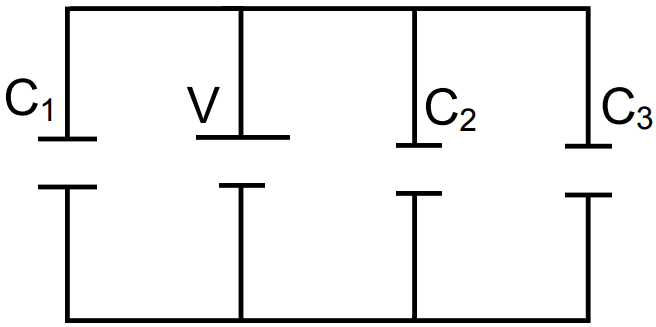
Find the charges on the three capacitors connected to a battery as shown in figure. Take $\text{C}_1=2.0\mu\text{F},\ \text{C}_2=4.0\mu\text{F},\ \text{C}_3=6.0\mu\text{F}$ and V = 12 volts.
  1. State Bohr’s postulate to define stable orbits in hydrogen atom. How does de Broglie’s hypothesis explain the stability of these orbits?
  2. A hydrogen atom initially in the ground state absorbs a photon which excites it to the n = 4 level. Estimate the frequency of the photon.
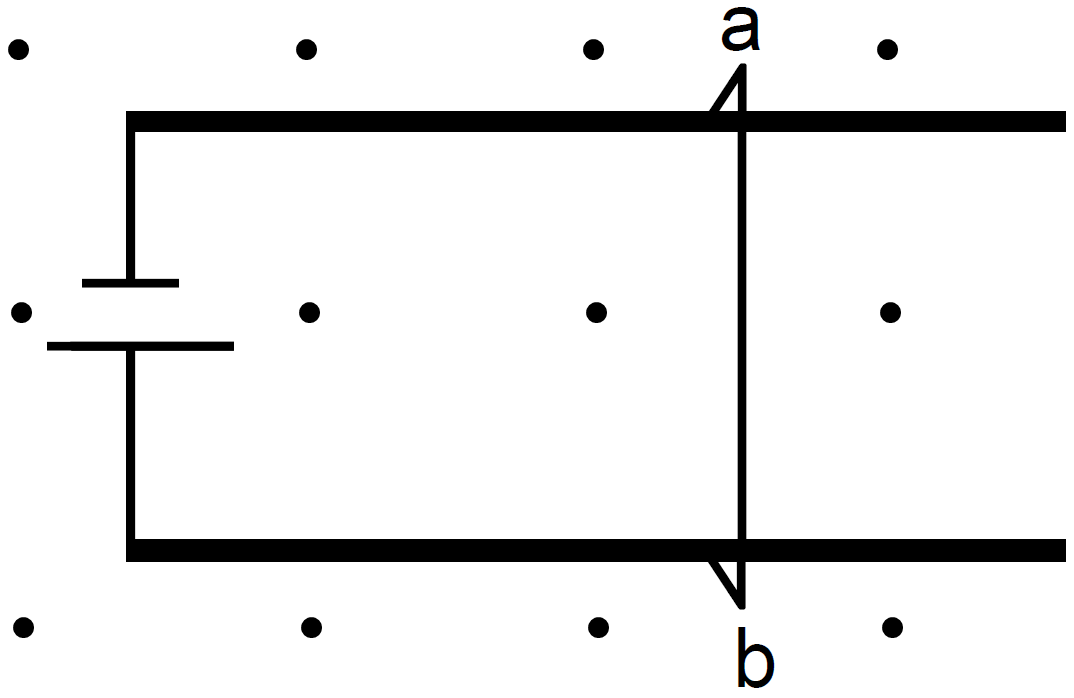
Figure shows a smooth pair of thick metallic rails connected across a battery of emf $\in$ having a negligible internal resistance. A wire ab of length l and resistance r can slide smoothly on the rails. The entire system lies in a horizontal plane and is immersed in a uniform vertical magnetic field B. At an instant t, the wire is given a small velocity u towards right.
  1. Find the current in it at this instant. What is the direction of the current?
  2. What is the force acting on the wire at this instant?
  3. Show that after some time the wire ab will slide with a constant velocity. Find this velocity.
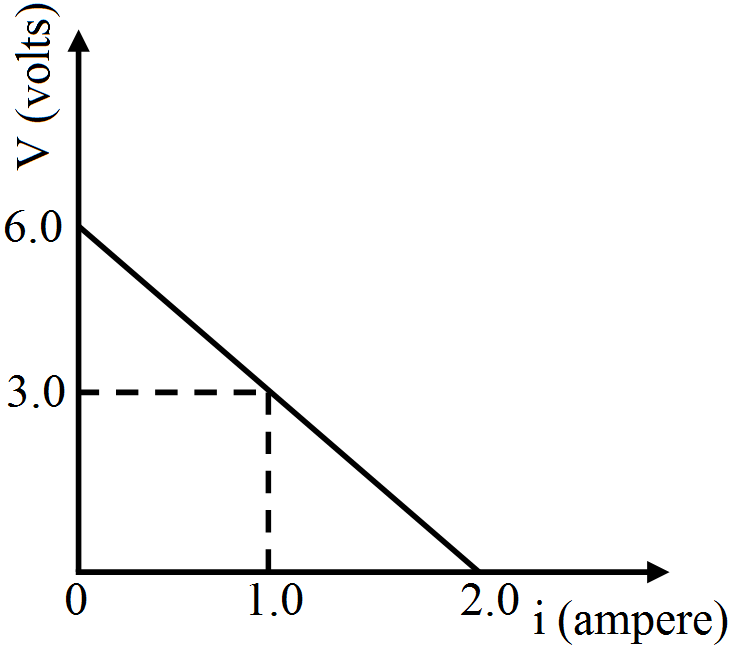
The graph shown here shows the variation of terminal potential difference V, across a combination of three cells in series to a resistor, versus current i:
  1. Calculate the emf of each cell.
  2. For what current i, will the power dissipation of the circuit be maximum?
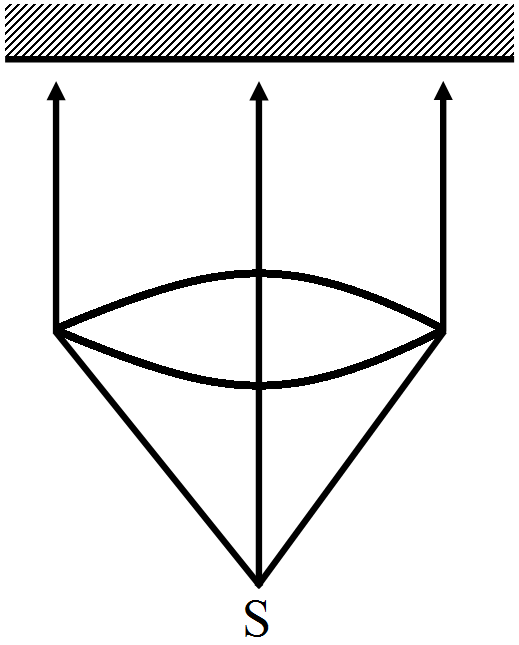
A totally reflecting, small plane mirror placed horizontally faces a parallel beam of light, as shown in the figure. The mass of the mirror is 20g. Assume that there is no absorption in the lens and that 30% of the light emitted by the source goes through the lens. Find the power of the source needed to support the weight of the mirror. Take $g = 10m/s^2.$​​​​​​​
Two identical coherent waves, each of intensity I, are producing an interference pattern. Find the value of the resultant intensity at a point of:
  1. Constructive interference.
  2. Destructive interference.
A nonconducting sheet of large surface area and thickness d contains uniform charge distribution of density $\rho.$ Find the electric field at a point P inside the plate, at a distance x from the central plane. Draw a qualitative graph of E against x for 0 < x < d.
A beam of light consisting of two wavelengths, $650 \ nm$ and $520 \ nm,$ are used to obtain interference fringes in a Young's double slit experiment.
$a$. Find the distance of the third bright fringe on the screen from the central maximum for wavelength $650 \ nm.$
$b$. What is the least distance from the central maximum where the bright fringes due to both the wavelengths coincide?
An alpha particle is accelerated through a potential difference of $100 V.$ Calculate:
$i.$ The speed acquired by the alpha particle, and
$ii.$ The de-Broglie wavelength associated with it. 
$($Take mass of alpha particle $=6.4 \times 10^{-27} kg )$