MCQ
Can two isothermal curves cut each other
  • Never
  • B
    Yes
  • C
    They will cut when temperature is $0°C$
  • D
    Yes, when the pressure is critical pressure

Answer

Correct option: A.
Never
a
(a) If isothermal curves cut each other then at equilibrium two temperature will be there which is impossible.

Need a full question paper?

Generate a complete, print-ready paper with questions like this in minutes — across 16+ boards, with answer keys.
Start Generating Free

Similar questions

In the wave equation $y =0.5 \sin \frac{2 \pi}{\lambda}(400 t - x )\,m$  the velocity of the wave will be ......... $m / s$
A copper block of mass $5.0\, kg$ is heated to a temperature of $500^{\circ} C$ and is placed on a large ice block. What is the maximum amount of ice (ઇન $kg$) that can melt? [Specific heat of copper: $0.39\, Jg ^{-1 \circ} C ^{-1}$ and latent heat of fusion of water : $335 \,J g ^{-1}$ ]
In order to shift a body of mass $m$ from a circular orbit of radius $3R$ to a higher radius $5R$ around the earth, the work done is
A body is projected at $t = 0$ with a velocity $10\,ms^{-1}$ at an angle of $60^o$ with the horizontal. The radius of curvature of its trajectory at $t=1\,s$ is $R.$ Neglecting air resistance and taking acceleration due to gravity $g = 10\,ms^{-2},$ the radius of $R$ is   ........ $m$
A diatomic gas $(\gamma=1.4)$ does $200 \mathrm{~J}$ of work when it is expanded isobarically. The heat given to the gas in the process is:
To an astronaut in a spaceship, the sky appears
The area of the parallelogram having diagonals ${3\hat i}\,\, + \,\,\hat j\,\, - \,\,2\hat k$ and $\hat i\,\, - \,\,3\hat j\,\, + \;\,4\hat k$ is
Three objects colored black, gray and white can withstand hostile conditions upto $2800\,^oC$. These objects are thrown into a furnace where each of them attains a temperature of $2000\,^oC$. Which object will glow brightest?
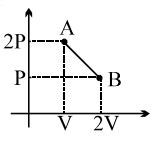
One mole of a gas expands obeying the relation as shown in the $P/V$ diagram. The maximum temperature in this process is equal to
A $40\ g$ ball dropped from a certain height bounces back from the horizontal ground without losing mechanical energy. If its speed is $10\ m/s$ just before making contact with the ground, and the average value of the force of the ground on the ball is equal to $16\ N$ while ball and wall are in contact, how long were they in contact .......... $m/s$