Question
Can we conclude from the interference phenomenon whether light is a transverse wave or a longitudinal wave?

Answer

The interference pattern can be produced by any two coherent waves moving in the same direction. It cannot be concluded from the interference phenomenon that light is a transverse wave, as sound waves that are longitudinal in nature also interfere.

Need a full question paper?

Generate a complete, print-ready paper with questions like this in minutes — across 16+ boards, with answer keys.
Start Generating Free

Similar questions

An iron needle is attracted to the ends of a bar magnet but not to the middle region of the magnet. Is the material making up the ends of a bar magnet different from that of the middle region?
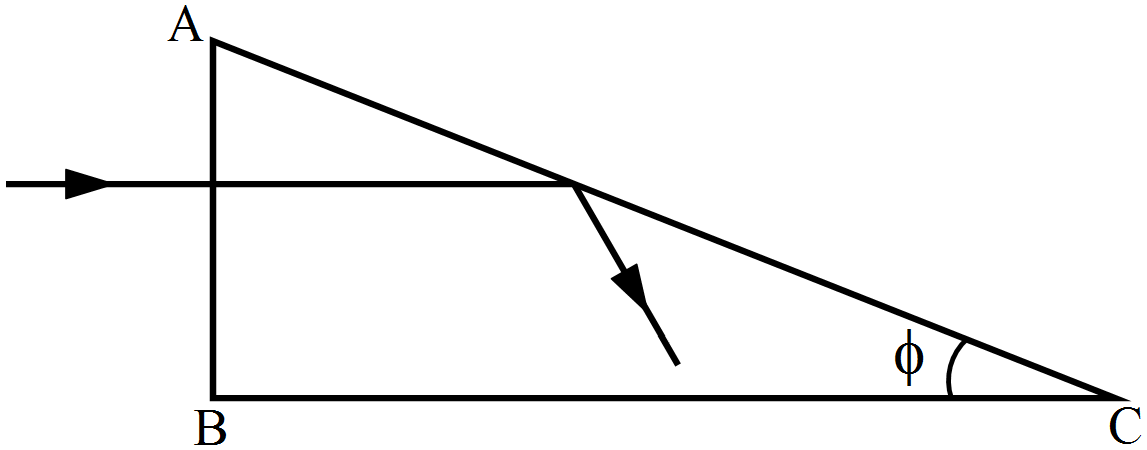
 A light ray is incident normally on the face AB of a right-angled prism ABC $(\mu=1.50)$ as shown in figure. What is the largest angle $\phi$ for which the light ray is totally reflected at the surface AC? 
A constant volume thermometer registers a pressure of $1.500 \times 10^4Pa$ at the triple point of water and a pressure of $2.050 \times 10^4Pa$ at the normal boiling point. What is the temperature at the normal boiling point?
A conducting circular loop having a radius of 5.0cm, is placed perpendicular to a magnetic field of 0.50T. It is removed from the field in 0.50s. Find the average emf produced in the loop during this time.
Describe schematically the equipotential surfaces corresponding to:
  1. a constant electric field in the z-direction.
  2. a field that uniformly increases in magnitude but remains in a constant (say, z) direction.
  3. a single positive charge at the origin, and.
  4. a uniform grid consisting of long equally spaced parallel charged wires in a plane.
A spherical shell is heated. The volume change according to the equation $\text{V}_\theta=\text{V}_\theta(1+\gamma\theta)$. Does the volume refer to the volume enclosed by the shell or the volume of the material making up the shell?
Find the intensity at a point on a screen in Young’s double slit experiment where the interfering waves have a path difference of (i) $\lambda/6$, and (ii) $\lambda/2.$
  1. The peak voltage of an ac supply is $300V$. What is the rms voltage?
  2. The rms value of current in an ac circuit is $10A$. What is the peak current?
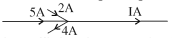
Write Kirchhoff's junction rule. Write the magnitude of current $I$ in the given figure.
Image
Using Bohr model, calculate the electric current created by the electron when the $H-$atom is in the ground state.