Question
Can we conclude from the interference phenomenon whether light is a transverse wave or a longitudinal wave?

Answer

The interference pattern can be produced by any two coherent waves moving in the same direction. It cannot be concluded from the interference phenomenon that light is a transverse wave, as sound waves that are longitudinal in nature also interfere.

Need a full question paper?

Generate a complete, print-ready paper with questions like this in minutes — across 16+ boards, with answer keys.

Start Generating Free

Similar questions

The separation between a node and the next antinode in a vibrating air column is 25cm. If the speed of sound in air is 340m/s, find the frequency of vibration of the air column.
Give the explanation of the velocity of $E M$ wave and derive the equation of refractive index $n=\sqrt{\mu_r K }$.
Find the dimensions of Planck's constant h from the equation E = hv where E is the energy and v is the frequency.
Explain dielectric strength and dielectric breakdown.
Answer the following question:
In viewing through a magnifying glass, one usually positions one’s eyes very close to the lens. Does angular magnification change if the eye is moved back?
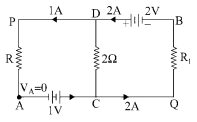
In the given figure, point A is at zero potential. Use Kirchhoff's rules to find out the potential at B.
Image
A gas thermometer measures the temperature from the variation of pressure of a sample of gas. If the pressure measured at the melting point of lead is 2.20 times the pressure measured at the triple point of water, find the melting point of lead.
Explain what happens when iron filings are sprinkled on a sheet of glass placed over a short bar magnet.
(a) When monochromatic light is incident on a surface separating two media, the reflected and refracted light both have the same frequency as the incident frequency. Explain why?
(b) When light travels from a rarer to a denser medium, the speed decreases. Does the reduction in speed imply a reduction in the energy carried by the light wave?
(c) In the wave picture of light, intensity of light is determined by the square of the amplitude of the wave. What determines the intensity of light in the photon picture of light.
Describe the two experiments related to static friction with diagram.