Question
Can we have a single north pole? A single south pole?

Answer

No we cannot have single pole magnet.A magnet always has two poles.

Need a full question paper?

Generate a complete, print-ready paper with questions like this in minutes — across 16+ boards, with answer keys.
Start Generating Free

Similar questions

When a dielectric slab is gradually inserted between the plates of an isolated parallel-plate capacitor, the energy of the system decreases. What can you conclude about the force on the slab exerted by the electric field?
In an unbiased p-n junction, holes diffuse from the p-region to n-region because,
  1. Free electrons in the n-region attract them.
  2. They move across the junction by the potential difference.
  3. Hole concentration in p-region is more as compared to n-region.
  4. All the above.
A point charge q is placed in a cavity in a metal block. If a charge Q is brought outside the metal, will the charge q feel an electric force?
A steel plate of face area $4\ cm^2$ and thickness $0.5\ cm$ is fixed rigidly at the lower surface. A tangential force of $10N$ is applied on the upper surface. Find the lateral displacement of the upper surface with respect to the lower surface. Rigidity modulus of steel $= 8.4 \times 10^{10}N/m^2.$
If the magnetic field outside a copper box is suddenly changed, what happens to the magnetic field inside the box? Such low-resistivity metals are used to form enclosures which shield objects inside them against varying magnetic fields.
Assume that the total surface area of a human body is $1.6m^2$ and that it radiates like an ideal radiator. Calculate the amount of energy radiated per second by the body if the body temperature is $37^\circ C.$ Stefan constant $\sigma$ is $6.0 \times 10^{-8}Wm^{-2}K^{-4}.$
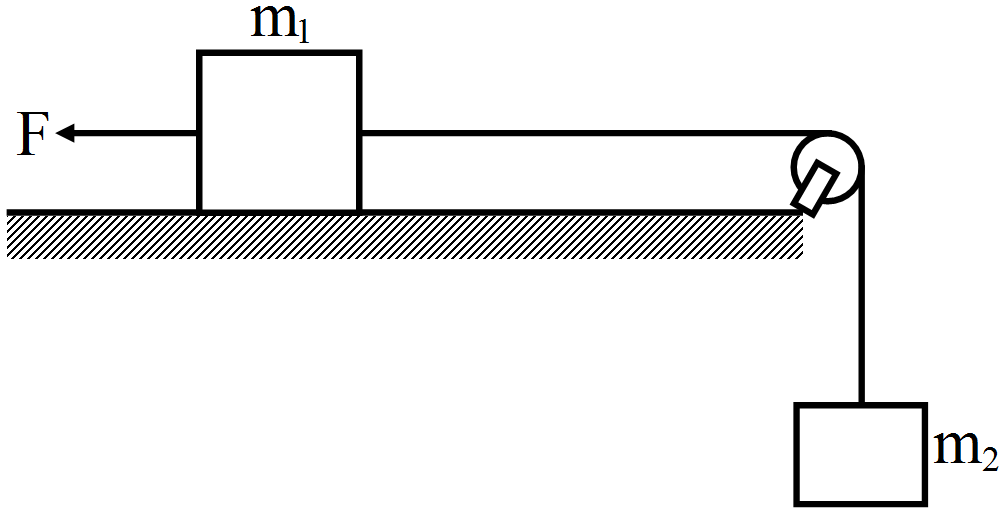
Consider the situation shown in The force F is equal to the $\frac{\text{m}_2\text{g}}{2}$ If the area of cross-section of the string is A and its Young's modulus Y, find the strain developed in it. The string is light and there is no friction anywhere.
In a rotating body, $\text{a}=\alpha\text{r}$ and $\text{v}=\omega\text{r}.$ Thus $\frac{\text{a}}{\alpha}=\frac{\text{v}}{\omega}.$ Can a co you use the theorems of ratio and proportion studied in algebra so as to write$\frac{\text{a}+\alpha}{\text{a}-\alpha}=\frac{\text{v}+\omega}{\text{v}-\omega}$
What is the direction of a current carrying solenoid when suspended freely in earth's horizontal plane?
The binding energy per nucleon of the two nuclei A and B are 4 MeV and 8.2 MeV. Which of the two nuclei is more stable?