Question
Can we have magnetic hysteresis in paramagnetic or diamagnetic substances?

Answer

No, magnetic hysteresis is the lagging of intensity of magnetization (I) behind magnetising force (H). When diamagnetic and paramagnetic materials are placed in a magnetic field they get weekly magnetised. Also, they lose their magnetization as the magnetic field is removed (low retentively). Therefore, they do not form magnetic hysteresis curve.

Need a full question paper?

Generate a complete, print-ready paper with questions like this in minutes — across 16+ boards, with answer keys.
Start Generating Free

Similar questions

Two charged particles, having equal charges of $2.0 \times 10^{-5}C$ each, are brought from infinity to within a separation of 10cm. Find the increase in the electric potential energy during the process.
A long cylindrical wire of radius b carries a current i distributed uniformly over its cross-section. Find the magnitude of the magnetic field at a point inside the wire at a distance a from the axis.
A cylinder rotating at an angular speed of 50rev/s is brought in contact with an identical stationary cylinder. Because of the kinetic friction, torques act on the two cylinders, accelerating the stationary one and decelerating the moving one. If the common magnitude of the acceleration and deceleration be one revolution per second square, how long will it take before the two cylinders have equal angular speed?
A difference of 2.3 eV separates two energy levels in an atom. What is the frequency of radiation emitted when the atom make a transition from the upper level to the lower level?
Consider the situation of the previous problem. Suppose the production of the radioactive isotope starts at t = 0. Find the number of active nuclei at time t.
A 12 pF capacitor is connected to a 50 V battery. How much electrostatic energy is stored in the capacitor? If another capacitor of 6 pF is connected in series with it with the same battery connected across the combination, find the charge stored and potential difference across each capacitor.
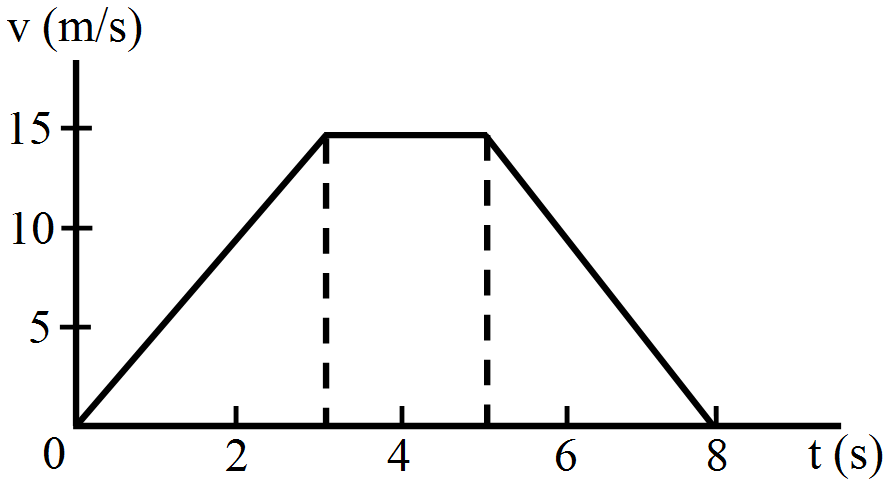
A particle of mass 50g moves on a straight line. The variation of speed with time is shown in figure. Find the force acting on the particle at t = 2, 4 and 6 seconds.
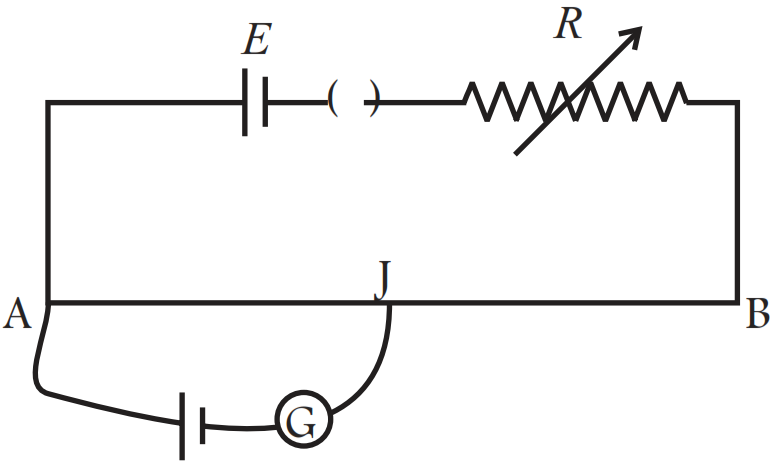
AB is a potentiometer wire (Fig). If the value of R is increased, in which direction will the balance point J shift?
A solenoid has a core of a material with relative permeability 400 . The windings of the solenoid are insulated from the core and carry a current of 2A. If the number of turns is 1000 per metre, calculate (a) $H$, (b) $M$, (c) $B$ and (d) the magnetising current $I_m$.
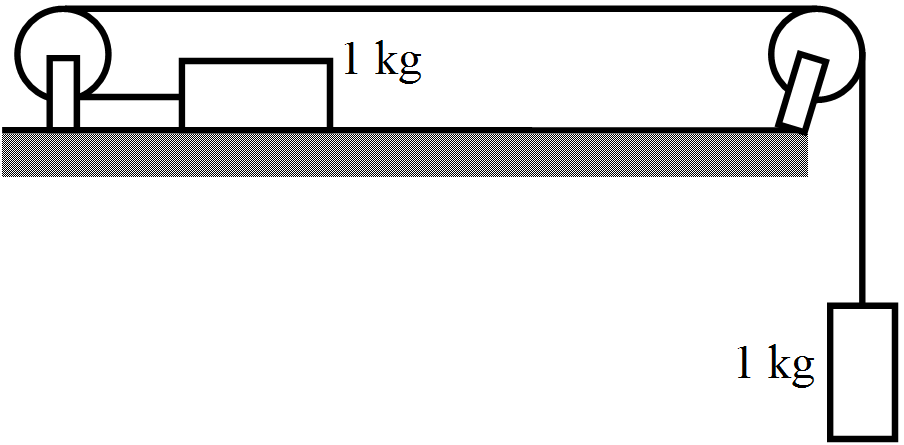
Calculate the tension in the string shown in figure. The pulley and the string are light and all surfaces are frictionless. Take $g = 10m/s^2.$