Question
Can you add three unit vectors to get a unit vector? Does your answer change if two unit vectors are along the coordinate axes?

Answer

Of course we can add three unit vectors to give a unit vector. An example of this is i, i, -i even If any two unit vectors are along the axes the third vector can so be aligned so that they give a vector of unit magnitude. I will give you an example: i, j, –i.

Need a full question paper?

Generate a complete, print-ready paper with questions like this in minutes — across 16+ boards, with answer keys.
Start Generating Free

Similar questions

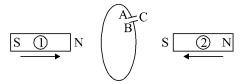
Two bar magnets are moving rapidly towards a metallic loop joined across a capacitor C as shown in the figure. What is the polarity of the capacitor?
Image
Suppose you are given a chance to repeat the alpha-particle scattering experiment using a thin sheet of solid hydrogen in place of the gold foil. (Hydrogen is a solid at temperatures below 14 K). What results do you expect?
Explain the rules for obtaining image due to reflection from a spherical mirror.
A car weighing 1400kg is moving at a speed of 54km/h up a hill when the motor stops. If it is just able to reach the destination which is at a height of 10m above the point, calculate the work done against friction (negative of the work done by the friction).
The capacitance of a parallel plate air capacitor is $8 \mu F$. The distance between its plates is halved and the space between the plates is filled with a medium having dielectric constant 5 . Find the capacitance of the capacitor in the second case.
Give a brief explanation about Radioactivity.
When the last image of the telescope is formed at infinity, then what is the length of its tube? If the image is formed at the minimum distance of clear vision then will the length be less or more than before?
Describe/Explain single slit diffraction using a simple day to day life example.
###
Describe a simple experiment (/activity) to see single slit diffraction.
A nut becomes loose and gets detached from a satellite revolving around the earth. Will it land on the earth? If yes, where will it land? If no, how can an astronaut make it land on the earth?
A point charge produces an electric field of magnitude 5.0NC-1 at a distance of 40cm from it. What is the magnitude of the charge?