Question
Can you add two vectors representing physical quantities having different dimensions? Can you multiply two vectors representing physical quantities having different dimensions?

Answer

Two quantities cannot be added or subtracted if they have different dimensions be it a vector or a scalar quantity. But they can be multiplied or divided, or only multiplied in the case of vectors.

Need a full question paper?

Generate a complete, print-ready paper with questions like this in minutes — across 16+ boards, with answer keys.
Start Generating Free

Similar questions

Show that the internal energy of the air (treated as an ideal gas) contained in a room remains constant as the temperature changes between day and night. Assume that the atmospheric pressure around remains constant and the air in the room maintains this pressure by communicating with the surrounding through the windows, doors, etc.
X-rays of wavelength $'\lambda'$ fall on a photosensitive surface, emitting electrons. Assuming that the work function of the surface can be neglected, prove that the de Broglie wavelength of electrons emitted will be $\sqrt{\frac{\text{h}\gamma}{2\text{mc}}}.$
According to the classical electromagnetic theory, calculate the initial frequency of the light emitted by the electron revolving around a proton in hydrogen atom.
Define the term ‘Half-life’ of a radioactive substance. Two different radioactive substances have half-lives T1 and T2 and number of undecayed atoms at an instant, N1 and N2, respectively. Find the ratio of their activities at that instant.
Light is incident from glass $(\mu=1.5)$ to air. Sketch the variation of the angle of deviation $\delta$ with the angle of incident i for 0 < i < 90°.
Calculate the potential energy of a system of two charges in an external field.
Explain the refraction of light from a denser medium to a rarer medium, using Huygen's principle.
Find the minimum and maximum wavelengths of sound in water that is in the audible range (20-20000Hz) for an average human ear. Speed of sound in water = 1450m/s.
The current in the forward bias is known to be more $(\sim\mu\text{A})$ than the current in the reverse bias $(\sim\mu\text{A})$.What is the reason, then, to operate the photodiode in reverse bias?
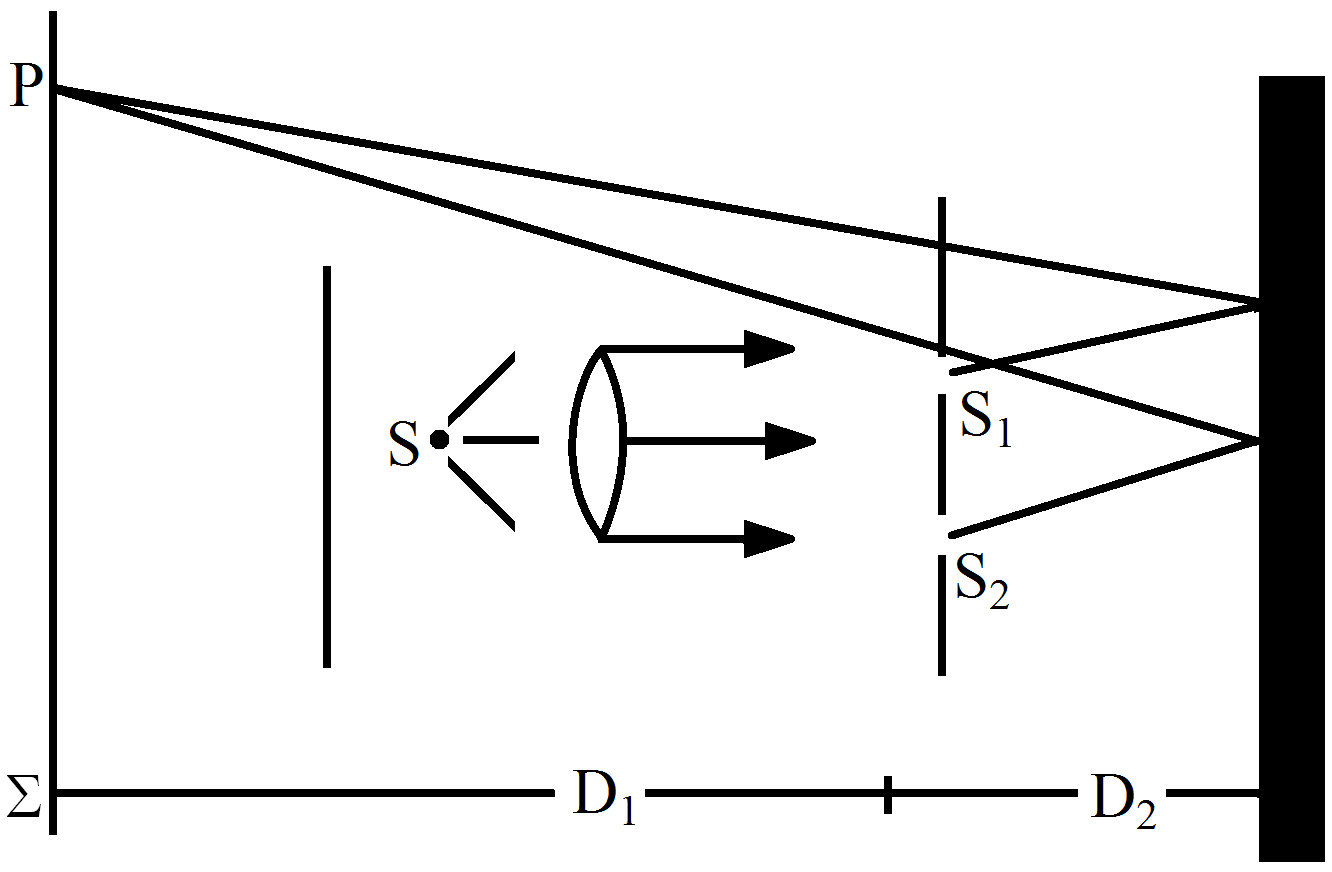
A double slit S1 - S2 is illuminated by a coherent light of wavelength $\lambda$. The slits are separated by a distance d. A plane mirror is placed in front of the double slit at a distance D1 from it and a screen $\sum$ is placed behind the double slit at a distance D2 from it (figure 17-E2). The screen E receives only the light reflected by the mirror. Find the fringe-width of the interference pattern on the screen.