Question
Can you design a heat Engine of 100% efficiency? Explain your answer.

Answer

The efficiency of a heat engine is $\eta=1-\frac{\text{T}_2}{\text{T}_1}$
The efficiency of heat engine will be 100% or 1 if,
T2 = 0K
Since temperature equal to 0K cannot be reached, so a heat engine cannot have 100 % efficiency.

Need a full question paper?

Generate a complete, print-ready paper with questions like this in minutes — across 16+ boards, with answer keys.
Start Generating Free

Similar questions

By evaluating $\int\text{i}^2\text{Rdt},$ show that when a capacitor is charged by connecting it to a battery through a resistor, the energy dissipated as heat equals the energy stored in the capacitor.
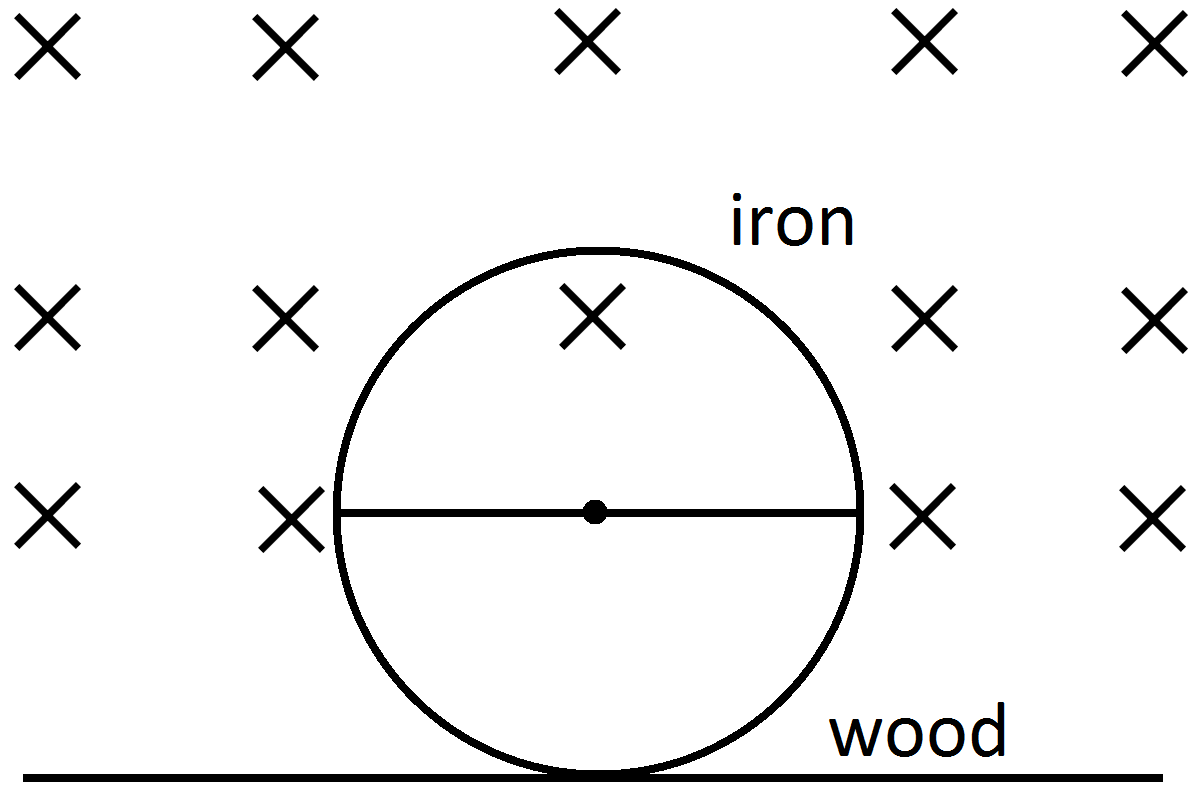
Figure shows a circular wheel of radius 10.0cm whose upper half, shown dark in the figure, is made of iron and the lower half of wood. The two junctions are joined by an iron rod. A uniform magnetic field B of magnitude 2.00 × 10⁻⁴ T exists in the space above the central line as suggested by the figure. The wheel is set into pure rolling on the horizontal surface. If it takes 2.00 seconds for the iron part to come down and the wooden part to go up, find the average emf induced during this period.

A planet moving around the sun is a good illustration of the law of conservation of energy. Explain.
Why are the tires of the wheels of heavy vehicles made wider?
Find the area enclosed by the curve $\text{y}=\sin\text{x}$ and the X-axis between $\text{x}=0$ and $\text{x}=\pi.$
A block of mass 5.0kg slides down an incline of inclination 30° and length 10m. Find the work done by the force of gravity.
A ball is thrown with a velocity of $15 ms^{-1}$ at angle $45^{\circ}$ with the horizontal. What is the range of ball? What is the time of flight for the ball to return to same plane from the point of throwing?
Two vessels made of two different metals are identical in all respects. They are completely filled with ice at 0°C. The ice in one is melted in 30 minutes and that in another in 10 minutes by heat coming from outside. Compare the thermal conductivities of metals.
Find the value of $x$ in the following relation.
$(\text { Velocity })^x=\binom{\text { Pressure }}{\text { difference }}^{3 / 2} \times(\text { Density })^{-3 / 2}$
A transverse harmonic wave on a string is described by
$\text{y}(\text{x, t})=3.0\sin\big(36\text{t}+0.018\text{x}+\frac{\pi}{4}\big)$
where x and y are in cm and t in s. The positive direction of x is from left to right.
What are its amplitude and frequency?