MCQ
Cannizzaro reaction is given by
  • $HCHO$
  • B
    $C{H_3}COC{H_3}$
  • C
    $C{H_3}CHO$
  • D
    $C{H_3}C{H_2}OH$

Answer

Correct option: A.
$HCHO$
a
It's Obvious.

Need a full question paper?

Generate a complete, print-ready paper with questions like this in minutes — across 16+ boards, with answer keys.
Start Generating Free

Similar questions

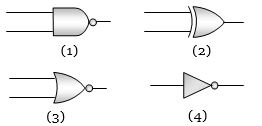
Given below are symbols for some logic gates The $XOR$ gate and $NOR$ gate respectively are
Which of the following does not give Fehling solution test?
A proton is fired from very far away towards a nucleus with charge $Q=120 \ e$, where $e$ is the electronic charge. It makes a closest approach of $10 \ fm$ to the nucleus. The de Brogle wavelength (in units of $fm$ ) of the proton at its start is :

(take the proton mass, $m _0=(5 / 3) \times 10^{-27} kg , h / e =4.2 \times 10^{-15} J / s / C ; \frac{1}{4 \pi \varepsilon_0}=9 \times 10^9 m / F ; 1 fm =10^{-15} m$ ) 

$105$ calories of heat is required to raise the temperature of $3$ moles of an ideal gas at constant pressure from $30^{\circ} C$ to $35^{\circ} C$. The amount of heat required in calories to raise the temperature of the gas through the range $\left(60^{\circ} C\right.$ to $\left.65^{\circ} C \right)$ at constant volume is ........ $cal$ $\left(\gamma=\frac{C_p}{C_v}=1.4\right)$
The work done per unit volume to stretch the length of area of cross-section $2 \,mm ^2$ by $2 \%$ will be ....... $MJ / m ^3$ $\left[Y=8 \times 10^{10} \,N / m ^2\right]$
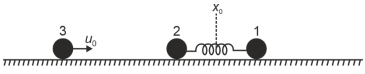
Two particles, $1$ and $2$ , each of mass $m$, are connected by a massless spring, and are on a horizontal frictionless plane, as shown in the figure. Initially, the two particles, with their center of mass at $x_0$, are oscillating with amplitude a and angular frequency $\omega$. Thus, their positions at time $t$ are given by $x_1(t)=\left(x_0+d\right)+a \sin \omega t$ and $x_2(t)=\left(x_0-d\right)-$ $a$ sin $\omega t$, respectively, where $d>2 a$. Particle $3$ of mass $m$ moves towards this system with speed $u_0=a \omega / 2$, and undergoes instantaneous elastic collision with particle 2 , at time $t_0$. Finally, particles $1$ and $2$ acquire a center of mass speed $v_{ cm }$ and oscillate with amplitude $b$ and the same angular frequency. . . . .

($1$) If the collision occurs at time $t_0=0$, the value of $v_{ cm } /(a \omega)$ will be

($2$) If the collision occurs at time $t_0=\pi /(2 \omega)$, then the value of $4 b^2 / a^2$ will be

Give the answer or quetion ($1$) and ($2$)
A point mass oscillates along the x-axis according to the law $x=x_0cos$$\left( {\omega t - \frac{\pi }{4}} \right)$ If the acceleration of the particle is written as $a=Acos$$\left( {\omega t + \delta } \right)$ then
A heat engine is involved with exchange of heat of $1915\, J,$ $-40\, J ,+125\, J$ and $-Q\,J$, during one cycle achieving an efficiency of $50.0 \%$. The value of $Q$ is.......$J$
A $U-$ tube is such that the diameter of one limb is $0.4\,mm$ and that of other is $d\, mm$ . If the surface tension of water contained in the tube is $0.07\,N/m$ and the difference in the levels of liquid in the limbs is $3.6\,cm,$ then the value of $d$ is
An ideal monoatomic gas expands to twice its volume. If the process is isothermal, the magnitude of work done by the gas is $W_i$. If the process is adiabatic, the magnitude of work done by the gas is $W_a$. Which of the following is true?