MCQ
Capacity of a parallel plate condenser can be increased by:
  • A
    Increasing the distance between the plates.
  • B
    Increasing the thickness of the plates.
  • C
    Decreasing the thickness of the plates.
  • Decreasing the distance between the plates.

Answer

Correct option: D.
Decreasing the distance between the plates.

Need a full question paper?

Generate a complete, print-ready paper with questions like this in minutes — across 16+ boards, with answer keys.
Start Generating Free

Similar questions

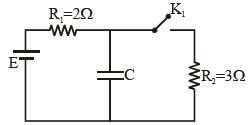
In the circuit shown in the figure $K_1$ is open. The charge on capacitor $C$ in steady state is $q_1$. Now key is closed and at steady state charge on $C$ is $q_2$. The ratio of charges $q_1/q_2$ is
The magnetism of magnet is due to
Which of the following are insulators.
In a nuclear reactor, the fuel is consumed at the rate of $1\, mg/s$. The power generated in kilowatt is
The ratio of intensities of two waves are given by 4 : 1. The ratio of the amplitudes of the two waves is
In a sample of hydrogen like atoms all of which are in ground state, a photon beam containing photons of various energies is passed. In absorption spectrum, five dark lines, are observed. The number of bright lines in the emission spectrum will be (assume that all transitions takes place).
In an energy emitting nuclear reaction the binding energies of reactants and products are $e_1, e_2$ respectively.Then which is correct of the following?
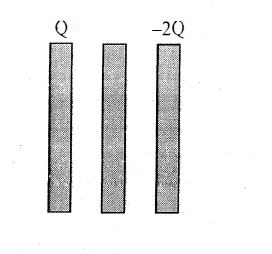
The identical metal plates with large surface areas are kept parallel to each other as shown in figure. The left most plate is given a charge $Q$ , the rightmost a charge $-2Q$ and the middle one remains neutral. Find the charge appearing on the outer surface of the rightmost plate
A metal cube is placed in an empty vessel. When water is filled in the vessel so that the cube is completely immersed in the water, the force on the bottom of the vessel in contact with the cube.
A mixture of light, consisting of wavelength $590\ nm$ and an unknown wavelength, illuminates Young's double slit and gives rise to two overlapping interference patterns on the screen. The central maximum ofboth lights coincide. Further, it is observed that the third bright fringe of known light coincides with the $4^{th }$ bright fringe of the unknown light. From this data, the wavelength of the unknown light is......$nm$