Question
“Capital is a liability for the business." Explain this statement with the principle applied.

Answer

In the above statement it is the Principle of Business Entity which is implied. As per this principle, business is treated as distinct and a separate entity from its owners. In simple words, we can say that business and its owners are different. In fact, the business (firm) borrows money from the owners (which is regarded as capital) and in return, the business pays interest on this money so borrowed from the owner. Thus, in this manner, the capital invested is a liability for a business. Hence, in accounting sense, it means one separate entity (owner) is assumed to be giving money to another distinct entity (business unit).

Need a full question paper?

Generate a complete, print-ready paper with questions like this in minutes — across 16+ boards, with answer keys.

Start Generating Free

Similar questions

Y purchased goods for ₹ 6,000 on 1st June, 2011 from X and on the same date accepted a bill payable after three months. 3 days later, X endorsed the bill to Z. On maturity, the bill was dishonoured for non-payment and Z had to pay ₹ 50 as noting charges. Two days after the dishonour of bill, Y paid ₹ 2,000 to X and requested him to draw a second bill for the balance plus ₹ 90 for the amount of interest, payable after two months. X accepted the proposal and draws the bill on Y, which was accepted by Y and was duly met on maturity. Pass Journal entries for the above transactions in the books of X.
2017
 
Jan 5
Sold to Ramesh Stationery House, Kolkata
50 Dozen Pencils @ ₹ 20 per doz.
20 Dozen Pens @ ₹ 5 per Pen
Trade Discount 10%
Jan 8
Sold to Gupta Stationery Shop, Kanpur
10 Dozen Note Books @ ₹ 60 per doz
15 Gross Rubbers @ ₹ 10 per doz.
Jan 20
Sold old newspapers for ₹ 150
Jan 24
Sold to Modern Stationery House, Lucknow for Cash
25 Dozen Pencils @ ₹ 22 per doz.
Jan 28
Sold to Ali Mohammad & Sons, Allahabad
10 Reams of Paper @ ₹ 80 per Ream
Discount 15%
Jan 31
Sold old furniture to Kedar Nath & Co., Allahabad on credit ₹ 2,200
Prepare Accounting Equation from the following:
  1. Started business with Cash ₹ 2,00,000.
  2. Purchased goods for Cash ₹ 60,000 and on Credit ₹ 1,50,000.
  3. Sold goods for Cash costing ₹ 40,000 at a profit of 20% and on Credit costing ₹ 72,000 at a profit of 25%.
  4. Paid for Rent ₹ 5,000.
Name the steps followed in accounting process.
“Only financial transactions are recorded in Accountancy.” Explain the statement.
What are Accounting Vouchers?
What is Sub-division of Journal?
How does a Cash Book serve 'Dual Purpose?
Explain the following briefly with appropriate example:
Money Measurement Concept.
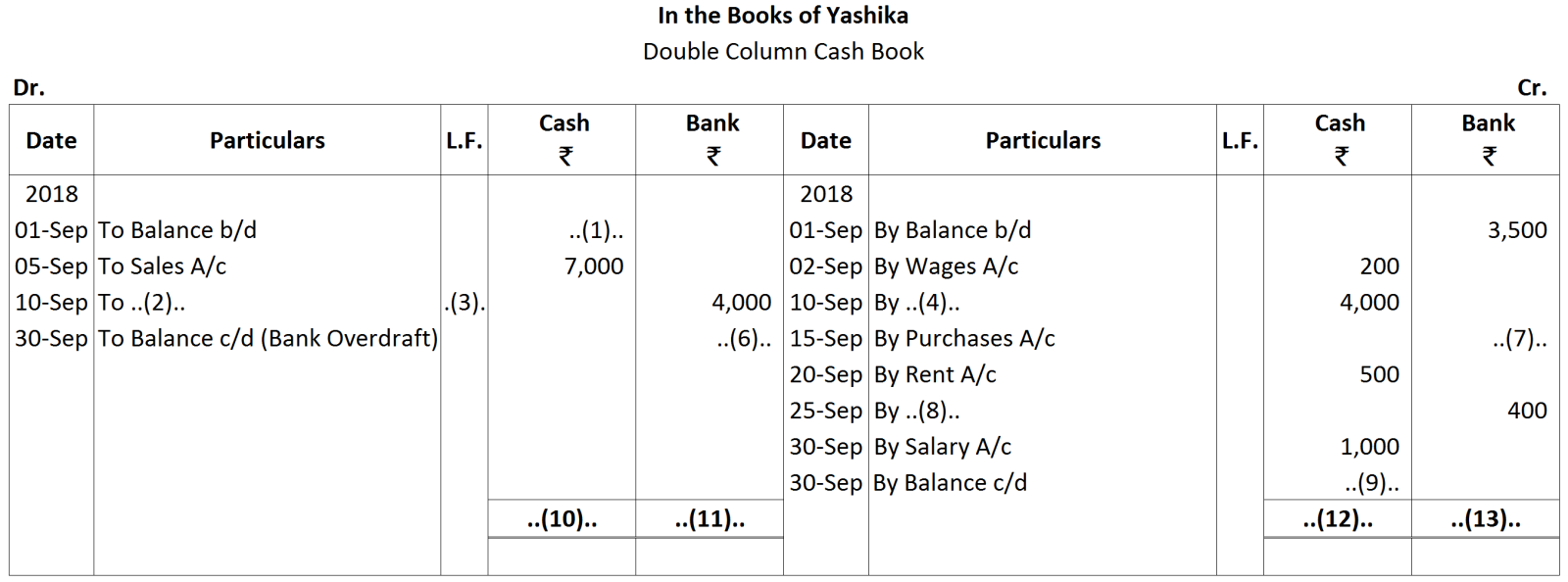
Determine the missing values of the Cash Book with Bank Column of Yashika 01 the basis of following transactions:
2018
 
Sept. 1
Cash in Hand
7,500
 
Bank Overdraft
3,500
Sept. 2
Paid Wages
200
Sept. 5
Cash Sales
7,000
Sept. 10
Cash Deposited into Bank
4,000
Sept. 15
Goods Purchased and Paid by Cheque
2,000
Sept. 20
Paid Rent
500
Sept. 25
Drew from bank for personal use
400
Sept. 30
Salary Paid
1,000