Carbon resistor has resistance specified by three bands having colour red, yellow and black. If this resistor is cut into two pieces of equal length then the new colour code of each one will be (Neglect tolerance of $4^{th}$ band)
Medium


Download our appand get started for free
Experience the future of education. Simply download our apps or reach out to us for more information. Let's shape the future of learning together!No signup needed.*
Similar Questions
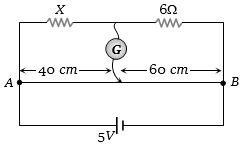
- 1In the circuit shown, a meter bridge is in its balanced state. The meter bridge wire has a resistance $0.1\, ohm/cm$. The value of unknown resistance $X$ and the current drawn from the battery of negligible resistance isView Solution
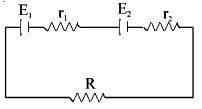
- 2Under what condition current passing through the resistance $R$ can be increased by short circuiting the battery of emf $E_2$. The internal resistances of the two batteries are $r_1$ and $r_2$ respectively.View Solution
- 3Consider a metallic cube of edge length $L$. Its resistance, $R$, measured across its opposite faces is $R =\frac{ m _{ e } v }{ ne ^2 L ^2}$, where $n$ is the number density and $v$ is the drift speed of electrons in the cube, and $e$ and $m _{ e }$ are the charge and mass of an electron respectively. Assuming the de-Broglie wavelength of the electron to be $L$, the maximum resistance of the sample is closest to ............. $\,\Omega$ $\left(e=1.60 \times 10^{-19} \,C ; m _{ e }=9.11 \times 10^{-31} \,kg\right.$; Planck's constant, $h=6.63 \times 10^{-34} \,Js$ )View Solution
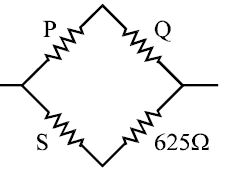
- 4$A$ Wheatstone's bridge is balanced with a resistance of $625\, \Omega$ in the third arm, where $P, Q$ and $S$ are in the $1^{st}, 2^{nd}$ and $4^{th}$ arm respectively. If $P$ and $Q$ are interchanged, the resistance in the third arm has to be increased by $51\,\Omega$ to secure balance. The unknown resistance in the fourth arm is ............. $\Omega$View Solution
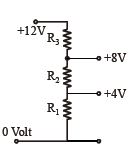
- 5A potential divider is used to give outputs of $4\,V$ and $8\,V$ from a $12\,V$ source. Which combination of resistances, $(R_1 : R_2 : R_3)$ gives the correct voltagesView Solution
- 6When a current $I$ is passed through a wire of constant resistance, it produces a potential difference $V$ across its ends. The graph drawn between $\log\, I$ and $\log\, V$ will beView Solution
- 7A resistance of $2 \Omega$ is comnected across one gap of a metre-bridge (the length of the wire is $100 \mathrm{~cm}$ ) and an unknown resistance, greater than $2 \Omega$, is connected across the other gap. When these resistance are interchanged, the balance point shifts by $20 \mathrm{~cm}$. Neglecting any corrections, the unknown resistance isView Solution
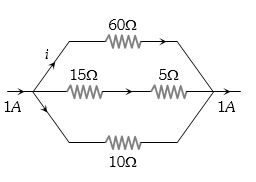
- 8The magnitude of $i$ in ampere unit isView Solution
- 9View SolutionThe reciprocal of resistance is
- 10A potentiometer circuit has been set up for finding the internal resistance of a given cell. The main battery, used across the potentiometer wire, has an emf of $2.0\,V$ and a negligible internal resistance. The potentiometer wire itself is $4\,m$ long. When the resistance $R,$ connected across the given cell, has values of $(i)$ infinity $(ii)$ $9.5\,\Omega$ the balancing lengths on the potentiometer wire are found to be $3\,m$ and $2.85\,m,$ respectively. The value of internal resistance of the cell is ............... $\Omega$View Solution