Question
Carbonyl compounds shows nucleophilic addition reaction, why?

Answer

In carbonyl compounds alkoxide ion formed by the attack of nucleophilic in first step is more stable than carbocation formed by the attack of electrophile. So carbonyl compounds shows nucleophilic addition reactions.

Need a full question paper?

Generate a complete, print-ready paper with questions like this in minutes — across 16+ boards, with answer keys.
Start Generating Free

Similar questions

Explain how rusting of iron is envisaged as setting up of an electrochemical cell.
Name the members of the lanthanoid series which exhibit +4 oxidation states and those which exhibit +2 oxidation states. Try to correlate this type of behaviour with the electronic configurations of these elements.
Arrange the following in order of property indicated for set.
CH3CHO, CH3CH2OH, CH3OCH3, CH3CH2CH3 (increasing order of boiling points).
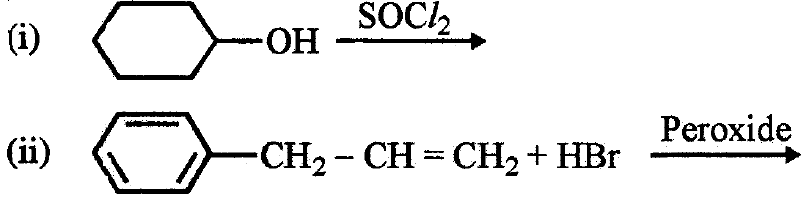
Draw the structure of major monohalo product in each of the following reactions:

For a reaction
$2\text{H}_2\text{O}_2\frac{\text{I}^-}{\text{alkaline medium}}2\text{H}_2\text{O}+\text{O}_2$
the proposed mechanism is as given below:
  1. $\text{H}_2\text{O}_2+\text{I}^{-}\xrightarrow{\ \ \ \ \ \ \ }\text{H}_2\text{O}+\text{IO}^{-}(\text{slow})$
  2. $\text{H}_2\text{O}_2+\text{IO}^{-}\xrightarrow{\ \ \ \ \ \ \ }\text{H}_2\text{O}+\text{I}^{-}+\text{O}_2(\text{fast})$
  1. Write rate law for the reaction.
  2. Write the overall order of reaction.
  3. Out of steps (1) and (2), which one is rate determining step?
How will you bring the following conversions?
Phenol to aspirin.
Explain the following terms:
  1. Invert sugar.
  2. Polypeptides.
A 1.00 molal aqueous solution of trichloroacetic acid (CCl3COOH) is heated to its boiling point. The solution has the boiling point of 100.18 °C. Determine the van't Hoff factor for trichloroacetic acid. (Kb for water = 0.512 K kg mol–1).
In what way is the electronic configuration of the transition elements different from that of the non transition elements?
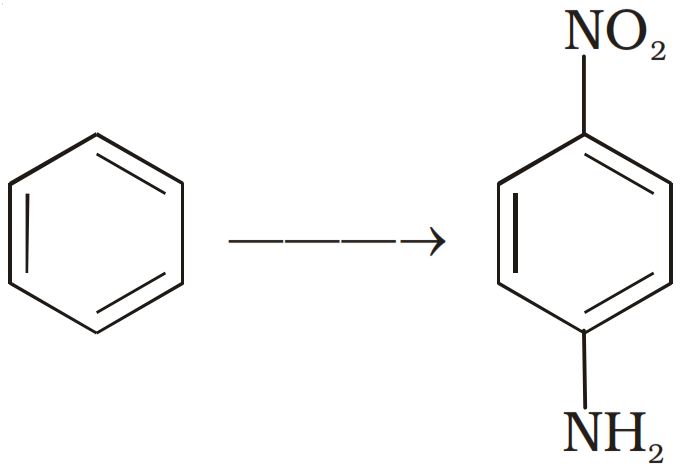
How will you carry out the following conversion?