Question
Cathode ray consists of:

Answer

  1. Electrons.

Need a full question paper?

Generate a complete, print-ready paper with questions like this in minutes — across 16+ boards, with answer keys.
Start Generating Free

Similar questions

The motion of planets in the solar system is an example of conservation of (a) Mass (b) Momentum(c) Angular momentum(d) Kinetic energy
       
Assertion   :   Free electron always keep on moving in a conductor even then no magnetic force act on them in magnetic field unless a current is passed through it.
Reason       : The average velocity of free electron is zero.(a) If both assertion and reason are true and the reason is the correct explanation of the assertion.(b) If both assertion and reason are true but reason is not the correct explanation of the assertion.(c) If assertion is true but reason is false.(d) If the assertion and reason both are false.


An electromagnetic wave of frequency v = 3.0MHz  passes from vacuum into a dielectric medium with permittivity ε = 4.0 . Then (a) Wavelength is doubled and the frequency remains unchanged(b) Wavelength is doubled and frequency becomes half(c) Wavelength is halved and frequency remains unchanged(d) Wavelength and frequency both remain unchanged


When a body is earth connected, electrons from the earth flow into the body. This means the body is….(a) Unchanged(b) Charged positively(c) Charged negatively(d) An insulator
       
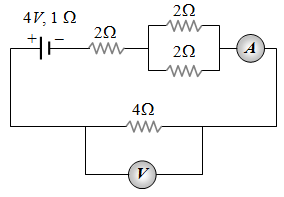
What is the equivalent resistance of the circuit
Equipotential surfaces of a single point charge are _____ surfaces centred at the charge.
If an electron oscillates at a frequency of 1 GHz it gives(a) X-rays (b) Mirowaves (c) Infrared rays (d) None of these
       
An electron revolves $6 \times 10^{15}$ times $/ \mathrm{sec}$ in circular loop. The current in the loop is
On using white light in Young's double slit experiment:
Assertion   :  Blue colour of sky appears due to scattering of blue colour.
Reason      : Blue colour has shortest wave length in visible spectrum.(a) If both assertion and reason are true and the reason is the correct explanation of the assertion.(b) If both assertion and reason are true but reason is not the correct explanation of the assertion.(c) If assertion is true but reason is false.(d) If the assertion and reason both are false.