MCQ
Cathode rays consist of
  • A
    Photons
  • Electrons
  • C
    Protons
  • D
    $\alpha $ -particles

Answer

Correct option: B.
Electrons
b
(b) Cathode rays are made up of negatively charged particles called electrons. These rays produce ionization of gases trough which they travel.

Need a full question paper?

Generate a complete, print-ready paper with questions like this in minutes — across 16+ boards, with answer keys.
Start Generating Free

Similar questions

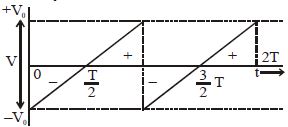
Find the rms value for the saw-tooth voltage of peak value $V_0$ from $t = 0$ to $t = 2T$ as shown in figure
In a region, electric field varies as $E = 2x^2 -4$ where $x$ is the distance in metre from origin along $x-$ axis. A positive charge of $1\,\mu C$ is released with minimum velocity from infinity for crossing the origin, then
A coil has 1,000 turns and 500 cm$^2$ as its area. The plane of the coil is placed at right angles to a magnetic induction field of $2 \times 10^{-5} \mathrm{wb} / \mathrm{m}^2$. The coil is rotated through 180° in 0.2 seconds. The average e.m.f. induced in the coil, in milli-volts, is 
In a region of constant potential:
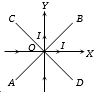
Two very thin metallic wires placed along $X$ and $Y$-axis carry equal currents as shown here. $AB$ and $CD$ are lines at $45^\circ $ with the axes with origin of axes at $O$. The magnetic field will be zero on the line
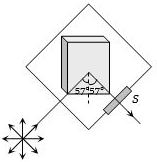
Figure represents a glass plate placed vertically on a horizontal table with a beam of unpolarised light falling on its surface at the polarising angle of $57^o $ with the normal. The electric vector in the reflected light on screen $S$ will vibrate with respect to the plane of incidence in a
The potentials of the two plates of capacitor are $+10\,V$ and $-10\, V$. The charge on one of the plates is $40 \,C$. The capacitance of the capacitor is........$F$
The fundamental frequency of a string is proportional to:
A parallel plate capacitor has $1\,\mu F$ capacitance. One of its two plates is given $+2\,\mu C$ charge and the other plate, $+4\,\mu C$ charge. The potential difference developed across the capacitor is......$V$
Which of the following are best suited to make the core of a transformer?