MCQ
$\ce{[Co(NH_3)_4(NO_2)_2]Cl}$ exhibits
  • A
    linkage isomerism, geometrical isomerism and optical isomerism
  • B
    linkage isomerism, ionization isomerism and optical isomerism
  • C
    linkage isomerism, ionization isomerism and geometrical isomerism
  • D
    ionization isomerism, geometrical isomerism and optical isomerism.

Answer

$\left.\begin{array}{l}{\left[\mathrm{Co}\left(\mathrm{NH}_{3}\right)_{4}\left(\mathrm{NO}_{2}\right)_{2}\right] \mathrm{Cl}} \\ {\left.\left[\mathrm{Co}\left(\mathrm{NH}_{3}\right)_{4}(\mathrm{NO})_{2}\right] \mathrm{Cl}\right] \mathrm{NO}_{2}}\end{array}\right\}$ lonisation isomer
$\left.\begin{array}{l}{\left[\mathrm{Co}\left(\mathrm{NH}_{3}\right)_{4}\left(\mathrm{NO}_{2}\right)_{2}\right] \mathrm{Cl}} \\ {\left.\left[\mathrm{Co}\left(\mathrm{NH}_{3}\right)_{4}(\mathrm{ONO})_{2}\right] \mathrm{Cl}\right] }\end{array}\right\}$Linkage isomers

Need a full question paper?

Generate a complete, print-ready paper with questions like this in minutes — across 16+ boards, with answer keys.

Start Generating Free

Similar questions

Solubility of $Th_3(PO_4)_4$ $(M_w = m)$ is $w\,g/100\,ml$ at $25\,^oC$ . $K_{SP}$ is
For the reaction, ${A_{(s)}} + 3{B_{(g)}} \to 4{C_{(s)}} + {D_{(l)}}$. $\Delta H$ and $\Delta U$ are related as ………
Match the LIST-I with LIST-II.
LIST-I
(Family)
LIST-II
(Symbol of Element)
A.Pnicogen (group 15)I.Ts
B.ChalcogenII.Og
C.HalogenIII.Lv
D.Noble gasIV.Mc
Choose the correct answer from the options given below :
The $IUPAC$ name of  (figure) is
Which one of the following reducing agents is likely to be the most effective in bringing about the following change

$R - \mathop {\mathop {C\,N{H_2} \to RC{H_2}N{H_2}}\limits^{||\,\,\,\,\,\,\,\,\,\,\,\,\,\,\,\,\,\,\,\,\,\,\,\,\,\,\,\,\,\,\,\,\,\,\,\,\,\,\,\,\,\,\,\,\,\,\,\,\,\,\,} }\limits^{O\,\,\,\,\,\,\,\,\,\,\,\,\,\,\,\,\,\,\,\,\,\,\,\,\,\,\,\,\,\,\,\,\,\,\,\,\,\,\,\,\,\,\,\,\,\,\,\,\,} $

Which of the following is considered as an anticancer species
$C{H_3}COO{H_{(l)}} + {C_2}{H_5}O{H_{(l)}}$ $\rightleftharpoons$ $C{H_3}COO{C_2}{H_{5\,(l)}} + {H_2}{O_{(l)}}$ In the above reaction, one mole of each of acetic acid and alcohol are heated in the presence of little conc. ${H_2}S{O_4}$. On equilibrium being attained
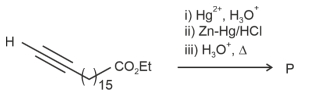
In the following reaction sequence, the major product $P$ is formed.  Glycerol reacts completely with excess $P$ in the presence of an acid catalyst to form $Q$. Reaction of $Q$ with excess $NaOH$ followed by the treatment with $CaCl _2$ yields $Ca$-soap $R$, quantitatively. Starting with one mole of $Q$, the amount of $R$ produced in gram is. . . . [Given, atomic weight: $H =1, C =12, N =14, O =16, Na =23, Cl =35, Ca =40$ ]
In the above given compound how many functional group reduced by $LAH$ (Lithium aluminium hydride ) and $SBH$ (sodium borohydride) respectively ?
The number of bridged oxygen atoms present in compound $B$ formed from the following reactions is

$Pb \left( NO _{3}\right)_{2} \stackrel{673 K }{\longrightarrow} A + PbO + O _{2}$

$A \stackrel{\text { Dimerise }}{\longrightarrow} B$