MCQ
$C{H_3}CON{H_2}\xrightarrow{{NaN{O_2}/HCl}}X$
  • $C{H_3}COOH$
  • B
    $C{H_3}CO\mathop N\limits^ + {H_3}C{l^ - }$
  • C
    $C{H_3}N{H_2}$
  • D
    $C{H_3}CHO$

Answer

Correct option: A.
$C{H_3}COOH$
a
(a)Amide, on treating with $HN{O_2},$ give acids.

$C{H_3}CON{H_2}\mathop {\xrightarrow{{NaN{O_2}/HCl}}}\limits_{(HN{O_2})} \mathop {C{H_3}COOH}\limits_{\,}  + {N_2} + {H_2}O$

Need a full question paper?

Generate a complete, print-ready paper with questions like this in minutes — across 16+ boards, with answer keys.

Start Generating Free

Similar questions

When $100 \ mL$ of $1.0 \ M \ HCl$ was mixed with $100 \ mL$ of $1.0 \ M \ NaOH$ in an insulated beaker at constant pressure, a temperature increase of $5.7^{\circ} C$ was measured for the beaker and its contents (Expt. $1$). Because the enthalpy of neutralization of a strong acid with a strong base is a constant $\left(-57.0 \ kJ \ mol ^{-1}\right)$, this experiment could be used to measure the calorimeter constant. In a second experiment (Expt. $2$), $100 \ mL$ of $2.0 \ M$ acetic acid $\left(K_a=2.0 \times 10^{-5}\right)$ was mixed with $100 \ mL$ of $1.0 M \ NaOH$ (under identical conditions to Expt. $1$) where a temperature rise of $5.6^{\circ} C$ was measured.

(Consider heat capacity of all solutions as $4.2 J g ^{-1} K ^{-1}$ and density of all solutions as $1.0 \ g mL ^{-1}$ )

$1.$ Enthalpy of dissociation (in $kJ mol ^{-1}$ ) of acetic acid obtained from the Expt. $2$ is

$(A)$ $1.0$ $(B)$ $10.0$ $(C)$ $24.5$ $(D)$ $51.4$

$2.$ The $pH$ of the solution after Expt. $2$ is

$(A)$ $2.8$ $(B)$ $4.7$ $(C)$ $5.0$ $(D)$ $7.0$

Give the answer question $1$ and $2.$
The sum of the mole fraction of the components of a solution is
Some reactions of amines are given. Which one is not correct ?
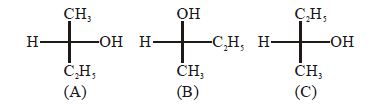
The correct statements about compounds $A, B$ and $C$ is/are
$C{H_3} - C{H_2} - C{H_2} - C{H_3}\xrightarrow{{B{r_2}/hv}}$

Major product in the above reaction is

The most paramagnetic complex is
Which of the following is general formula of alkane amide ?
Metal halide which is insoluble in water is
The ionization enthalpy of hydrogen atom is $1.312 \times 10^6\, J\, mol^{-1}.$ The energy required to excite the electron in the atom from $n= 1$ to $n=2$ is
The solution from the following with highest depression in freezing point/lowest freezing point is