Question
Characteristic X-rays may be used to identify the element from which they are being emitted. Can continuous X-rays be used for this purpose?

Answer

Characteristic X-rays are emitted due to the transitions of electrons among different shells. The wavelength of the X-rays emitted in these transitions have definite value for a particular element. But continuous X-rays are emitted due to the conversion of kinetic energy of an electron into photon, which varies from collision to collision and is independent of material. Hence, continuous X-rays provide no information about the element from which they are being emitted.

Need a full question paper?

Generate a complete, print-ready paper with questions like this in minutes — across 16+ boards, with answer keys.
Start Generating Free

Similar questions

Can normal force do a nonzero work on an object. If yes, give an example. If no, give reason.
Draw the circuit diagram of a full-wave rectifier. Explain full-wave rectification in brief. Also draw input-output waveforms.
In a Young’s double-slit experiment, the slits are separated by 0.28 mm and the screen is placed 1.4 m away. The distance between the central bright fringe and the fourth bright fringe is measured to be 1.2 cm. Determine the wavelength of light used in the experiment.
Find the angle of minimum deviation for an equilateral prism made of a material of refractive index 1.732. What is the angle of incidence for this deviation?
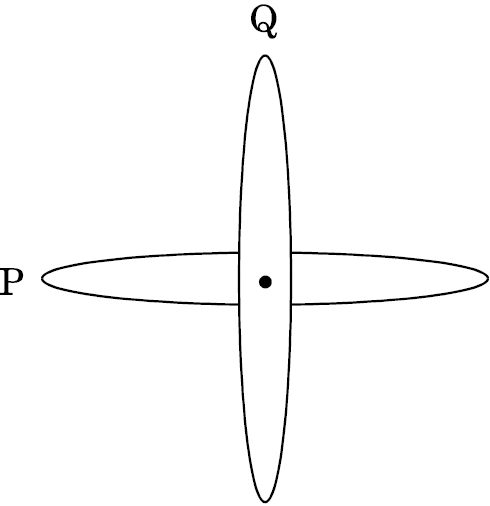
Two identical loops P and Q each of radius 5 cm are lying in perpendicular planes such that they have a common centre as shown in the figure. Find the magnitude and direction of the net magnetic field at the common centre of the two coils, if they carry currents equal to 3 A and 4 A respectively.

  1. A rod of length l is moved horizontally with a uniform velocity ‘v’ in a direction perpendicular to its length through a region in which a uniform magnetic field is acting vertically downward. Derive the expression for the emf induced across the ends of the rod.
  2. How does one understand this motional emf by invoking the Lorentz force acting on the free charge carriers of the conductor? Explain.
The focal lengths of a convex lens for red, yellow and violet rays are 100cm, 98cm and 96cm respectively. Find the dispersive power of the material of the lens.
A bar magnet of magnetic moment 1.5 J T–1 lies aligned with the direction of a uniform magnetic field of 0.22 T.
  1. What is the amount of work required by an external torque to turn the magnet so as to align its magnetic moment: (i) normal to the field direction, (ii) opposite to the field direction?
  2. What is the torque on the magnet in cases (i) and (ii)?
Define a magnet and write its characteristics of directive property and pole strength.
A concave mirror has a focal length of 20cm. Find the position or positions of an object for which the imagesize is double of the object-size.