Question
Characteristic X-rays may be used to identify the element from which they are being emitted. Can continuous X-rays be used for this purpose?

Answer

Characteristic X-rays are emitted due to the transitions of electrons among different shells. The wavelength of the X-rays emitted in these transitions have definite value for a particular element. But continuous X-rays are emitted due to the conversion of kinetic energy of an electron into photon, which varies from collision to collision and is independent of material. Hence, continuous X-rays provide no information about the element from which they are being emitted.

Need a full question paper?

Generate a complete, print-ready paper with questions like this in minutes — across 16+ boards, with answer keys.
Start Generating Free

Similar questions

Three moles of a diatomic gas is mixed with two moles of monoatomic gas. What will be the molecular specific heat of the mixture at constant volume? [given, $R = 8.31J-mol^{-1}K^{-1}$]
The flow rate of water is $0.58 L / mm$ from a tap of diameter of 1.30 cm . After some time, the flow rate is increased to $4 L / min$. Determine the nature of the flow for both the flow rates. The coefficient of viscosity of water is $10^{-3} Pa- s$ and the density of water is $10^3 kg / m ^3$.
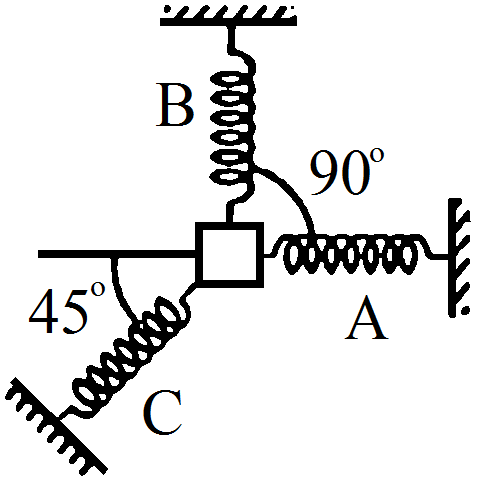
A particle of mass in is attatched to three springs A, B and C of equal force constants k as shown in figure If the particle is pushed slightly against the spring C and released, find the time period of oscillation.
A hospital uses an ultrasonic scanner to locate tumours in a tissue. What is the wavelength of sound in the tissue in which the speed of sound is $1.7km s^{–1}$? The operating frequency of the scanner is $4.2$ MHz.
Define centripetal acceleration. Give two examples.
What is an elastic collision? What will happen, when
  1. A heavy body collides with a light mass at rest.
  2. A light body collides with a heavy mass at rest.
A police van moving on a highway with a speed of $30km h^{–1}$ fires a bullet at a thief’s car speeding away in the same direction with a speed of $192km h^{–1}​​​​​​​$. If the muzzle speed of the bullet is $150m s^{–1}​​​​​​​$, with what speed does the bullet hit the thief’s car? (Note: Obtain that speed which is relevant for damaging the thief’s car).
Precise measurements of physical quantities are a need of science. For example, to ascertain the speed of an aircraft, one must have an accurate method to find its positions at closely separated instants of time. This was the actual motivation behind the discovery of radar in World War II. Think of different examples in modern science where precise measurements of length, time, mass etc. are needed. Also, wherever you can, give a quantitative idea of the precision needed.
A short magnet is moved along the axis of a conducting loop. Show that the loop repels the magnet if the magnet is approaching the loop and attracts the magnet if it is going away from the loop.
A body of mass 0.5kg travels in a straight line with velocity $\text{v}=\text{ax}^{3/2}$ where $\text{a}=5\text{m}^{-1/2}\text{s}^{-1}.$ What is the work done by the net force during its displacement from x = 0 to x = 2m?