MCQ
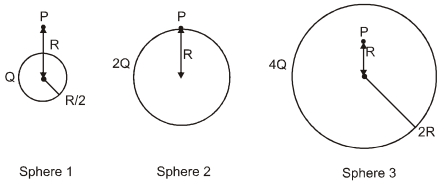
Charges $Q, 2Q$ and $4Q$ are uniformly distributed in three dielectric solid spheres $1,2$ and $3$ of radii $R/2, R$ and $2 R$ respectively, as shown in figure. If magnitudes of the electric fields at point $P$ at a distance $R$ from the centre of spheres $1,2$ and $3$ are $E_1 E_2$ and $E_3$ respectively, then
  • A
    $E_1 > E_2 > E_3$
  • B
    $E_3 > E_1 > E_2$
  • $E_2 > E_1 > E_3$
  • D
    $E_3 > E_2 > E_1$

Answer

Correct option: C.
$E_2 > E_1 > E_3$
c
$E_1=\frac{K Q}{R^2}$

$E_2=\frac{k(2 Q)}{R^2} \quad \Rightarrow \quad E_2=\frac{2 k Q}{R^2}$

$E_3=\frac{k(4 Q) R}{(2 R)^3} \quad \Rightarrow \quad E_3=\frac{k Q}{2 R^2}$

$E_3 < E_1 < E_2$

Need a full question paper?

Generate a complete, print-ready paper with questions like this in minutes — across 16+ boards, with answer keys.

Start Generating Free

Similar questions

A car is moving with high velocity when it has a turn. A force acts on it outwardly because of
A plane electromagnetic wave of frequency20 MHz travels in free space along the $+x$ direction. At a particular point in space and time, the electric field vector of the wave is $E _{ y }=9.3 Vm ^{-}$ ${ }^1$. Then, the magnetic field vector of the wave at that point is-
We wish to see inside an atom. Assuming the atom to have a diameter of $100\ pm$, this means that one must be able to resolved a width of say $10\ p.m$. If an electron microscope is used, the minimum electron energy required is about....... $KeV$
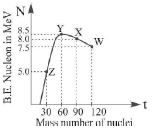
Binding energy per nucleon versus mass number curve for nuclei is shown in the figure. $W, X, Y$ and $Z$ are four nuclei indicated on the curve. The process that would release energy is
With the increase in principle quantum number, the energy difference between the two successive energy levels
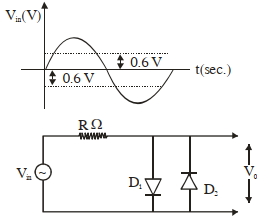
In the given circuit the input voltage $V _{\text {in }}$ is shown in figure. The cut-in voltage of $p - n$ junction diode ( $D_{1}$ or $D_{2}$ ) is $0.6\,V$. Which of the following output voltage $\left( V _{0}\right)$ waveform across the diode is correct?
An object of mass $80 \,kg$ moving with velocity $2 \,ms ^{-1}$ hit by collides with another object of mass $20 \,kg$ moving with velocity $4 \,ms ^{-1}$. Find the loss of energy assuming a perfectly inelastic collision ........... $J$
Work done by $0.1$ mole of a gas at ${27^o}C$ to double its volume at constant pressure is ....... $cal$ ($R = 2 \,cal\, mol^{-1}$ $^oC^{-1}$)
Two identical cells send the same current in $2\,\Omega $ resistance, whether connected in series or in parallel. The internal resistance of the cell should be ............... $\Omega$
The electrostatic potential due to an electric dipole at a distance ' $r$ ' varies as :