Question
Check the commutativity and associativity of the following binary operations:
'*' on R defined by a * b = a + b - 7 for all a, b ∈ R.

Answer

Commutativity: Let $\text{a, b}\in\text{R}.$ Then,a * b = a + b - 7
= b + a - 7
= b * a
⇒ a * b = b * a
⇒ * is commutative on R.
Associativity: Let $\text{a, b, c}\in\text{R}.$ Then,
(a * b) * c = (a + b - 7) * c
= a + b - 7 + c - 7
= a + b + c - 14 .......(i)
and a * (b * c) = a * (b + c - 7)
= a + b + c - 7 - 7
= a + b + c - 14 ......(ii)
From (i) and (ii)
(a * b) * c = a *( b * c)
* is associative on R.
Thus, * is associative on R.

Need a full question paper?

Generate a complete, print-ready paper with questions like this in minutes — across 16+ boards, with answer keys.
Start Generating Free

Similar questions

Represent the following families of curves by forming the corresponding differential equation:
$\text{y}^2=4\text{a}(\text{x}-\text{b})$
Consider the binary operations * : R × R → R and o : R × R → R defined as a * b = | a – b | and a o b = a for all a, b $\in$ R. Show that '*' is commutative but not associative, 'o' is associative but not commutative.
Find $\text{X if Y}=\begin{bmatrix}3&2\\1&4\end{bmatrix}$ and $2\text{X}+\text{Y}=\begin{bmatrix}1&0\\-3&2\end{bmatrix}$
Prove the following results:
$\frac{9\pi}{4}-\frac{9}{4}\sin^{-1}\frac{1}{3}=\frac{9}{4}\sin^{-1}\frac{2\sqrt2}{3}$
Find $\lambda$ when the projection of $\vec{\text{a}}=\lambda\hat{\text{i}}+\hat{\text{j}}+4\hat{\text{k}}$ on $\vec{\text{b}}=2\hat{\text{i}}+6\hat{\text{j}}+3\hat{\text{k}}$ is 4 units.
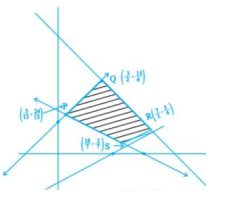
In Fig, the feasible region $($shaded$)$ for a $\text{LPP}$ is shown. Determine the maximum and minimum value of $Z =x+2y$
Image

Solve the Linear Programming Problem graphically:
Maximize $Z = 3x + 4y$ Subject to
$2 x+2 y \leq 80$
$2 x+4 y \leq 120$
If a, b, c are non-zero real numbers and if the system of equations
(a - 1)x = y + z
(b - 1)y = z + x
(c - 1)z = x + y
has a non-trivial solution, then prove that ab + bc + ca = abc.
For each of the differential equations given in find the general solution:
$(\text{x}+3\text{y}^2)\frac{\text{dy}}{\text{dx}}=\text{y}(\text{y}>0)$
Solve the following equation $\cos(\tan^{-1}\text{x})=\sin\Big(\cot^{-1}\frac{3}{4}\Big).$
Find the general solution of the differential equation ${e^x}\tan ydx + \left( {1 - {e^x}} \right){\sec ^2}y\,dy = 0$