MCQ
Check up the only correct statement in the following :-
  • A
    A body has a constant velocity and still it can have a varying speed.
  • A body has a constant speed but it can have a varying velocity.
  • C
    A body having constant speed cannot have any acceleration.
  • D
    A body in motion under a force acting upon it must always have work done upon it.
Answer

Correct option: B.
A body has a constant speed but it can have a varying velocity.
b
When a body possesses constant velocity, both its magnitude (i.e., seed) and direction must remain constant. On the other hand, if the speed of a body is constant, then its velocity may or may not remain constant. For example, in uniform circular motion, through the speed of a body remains constant, velocity changes from point to point due to a change in direction. A body moving with a constant speed along a circular path constantly experiences a centripetal acceleration.

Need a full question paper?

Generate a complete, print-ready paper with questions like this in minutes — across 16+ boards, with answer keys.

Start Generating Free

Similar questions

The slopes of isothermal and adiabatic curves are related as
How many times is escape velocity $({V_e})$, of orbital velocity $({V_0})$ for a satellite revolving near earth
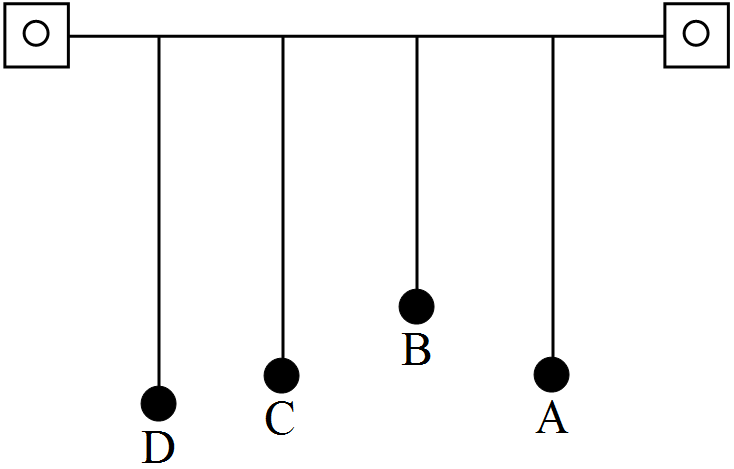
Four pendulums $A, B, C$ and $D$ are suspended from the same elastic support as shown in Fig $A$ and $C$ are of the same length, while $B$ is smaller than $A$ and $D$ is larger than $A$. If $A$ is given a transverse displacement,
The equation of a wave on a string oflinear mass density $0.04$ $kgm^{-1}$ is given by

$y = 0.02sin\left[ {2\pi \left( {\frac{t}{{0.04\left( s \right)}} - \frac{x}{{0.50\left( m \right)}}} \right)} \right]m$ The tension in the string is  .... $N$

The density of water at $20^oC$ is $0.998\  gm/cm^3$ and at $40^oC$ is $0.992\ gm/cm^3$. The mean coefficient of cubical expansion (in per ${}^oC$) is
A particle of mass $m$ in a unidirectional potential field have potential energy $U(x)=\alpha+2 \beta x^2$, where $\alpha$ and $\beta$ are positive constants. Find its time period of oscillation.
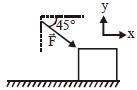
A person pushes a box kept on a horizontal surface with force of $100\,N$ . In unit vector notation force $\vec F$ can be expressed as ?
A car accelerates on a horizontal road due to the force exerted by:
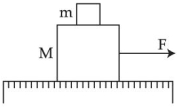
A system of two blocks of masses $m =2 \; kg$ and $M=8 \; kg$ is placed on a smooth table as shown in figure. The coefficient of static friction between two blocks is $0.5$. The maximum horizontal force $F$ that can be applied to the block of mass $M$ so that the blocks move together will be $\dots \; N$
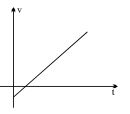
From the velocity time garph of a particle moving in straight line decide which of the following is incorrect statement.