Question
Check whether the following sequence is in A.P.
9, 13, 17, 21, 25, ...

Answer

$9,13,17,21,25, \ldots$
$t_2-t_1=13-9=4$
$t_3-t_2=17-13=4$
$t_4-t_3=21-17=4$
$t_5-t_4=25-21=4$
Common difference are equal
$\therefore$ The sequence is in A.P.

Need a full question paper?

Generate a complete, print-ready paper with questions like this in minutes — across 16+ boards, with answer keys.
Start Generating Free

Similar questions

In the matrix $A=\left[\begin{array}{cccc}8 & 9 & 4 & 3 \\ -1 & \sqrt{7} & \frac{\sqrt{3}}{2} & 5 \\ 1 & 4 & 3 & 0 \\ 6 & 8 & -11 & 1\end{array}\right]$, write The number of elements
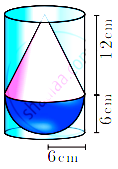
A solid consisting of a right circular cone of height 12 cm and radius 6 cm standing on a hemisphere of radius 6 cm is placed upright in a right circular cylinder full of water such that it touches the bottom. Find the volume of the water displaced out of the cylinder, if the radius of the cylinder is 6 cm and height is 18 cm
Simplify $\frac{x+2}{x+3}+\frac{x-1}{x-2}$
Find the first four terms of the sequences whose $n^{\text {th }}$ terms are given by $a_n=2 n^2-6$
The horizontal distance between two buildings is 70 m. The angle of depression of the top of the first building when seen from the top of the second building is 45°. If the height of the second building is 120 m, find the height of the first building
Let A = {9, 10, 11, 12, 13, 14, 15, 16, 17} and let f : A → N be defined by f(n) = the highest prime factor of n ∈ A. Write f as a set of ordered pairs and find the range of f.
Prove the following identities.
$(\sin θ + \sec θ)^2 + (\cos θ + cosec\ θ)^2 = 1 + (\sec θ + cosec\ θ)^2$
Let A = {x ∈ W | x < 2}, B = {x ∈ N | 1 < x < 4} and C = {3, 5}. Verify that A × (B ∪ C) = (A × B) ∪ (A × C)
Check whether AD is bisector of ∠A of ∆ABC of the following
AB = 5 cm, AC = 10 cm, BD = 1.5 cm and CD = 3.5 cm
The distance $S$ object travel under the influence of gravity in time $t$ seconds is given by $S ( t )=\frac{1}{2} gt ^2+$ $at + b$ where, ( $g$ is the acceleration due to gravity), $a , b$ are constant. Verify whether the function $S ( t )$ is one-one or not.