MCQ
Chemical bond implies ___________.
  • A
    Repulsion
  • B
    Attraction
  • C
    Attraction and repulsion balanced at a particular distance.
  • D
    Attraction and repulsion

Answer

  1. Attraction and repulsion balanced at a particular distance.

Explanation:

Chemical bond is an attraction between atoms that allows the formation of chemical substances.

The bond will be formed where attraction forces due to opposite charges were balanced by repulsion forces due to similar charges.

Need a full question paper?

Generate a complete, print-ready paper with questions like this in minutes — across 16+ boards, with answer keys.

Start Generating Free

Similar questions

Consider the hypothetical situation where the azimuthal quantum number, $l$, takes values $0$ , $1,2, \ldots \ldots n+1,$ where $n$ is the principal quantum number. Then, the element with atomic number
The reaction of $\mathrm{H}_{3} \mathrm{N}_{3} \mathrm{B}_{3} \mathrm{Cl}_{3}$ $(A)$ with $\mathrm{LiBH}_{4}$ in tetrahydrofurane gives inorganic benzene $(B)$. Further, the reaction of $(A)$ with $(C)$ leads to $\mathrm{H}_{3} \mathrm{N}_{3} \mathrm{B}_{3}(\mathrm{Me})_{3}$. than Compounds $(\mathrm{B})$ and $(\mathrm{C})$ respectively, are
Which of the following is not true about potash alum
The table shown below gives the bond dissociation energies $({E_{diss}})$ for single covalent bonds of carbon $(C)$ atoms with element $A,\,\,B,\,\,C$ and $D.$ Which element has the smallest atoms
$Bond$ $E_{(diss)}(kJ(mol )^{(-1)})$
$C-A$ $240$
$C-B$ $328$
$C-C$ $276$
$C-D$ $485$
In polythionic acid, $\mathrm{H}_{2} \mathrm{~S}_{\mathrm{x}} \mathrm{O}_{6}(\mathrm{x}=3$ to $5$ ) the oxidation state(s) of sulphur is/are :
Which one of the following arrangement represents the correct order of electron gain enthalpy of the given atomic species?
The atomic number of an element which shows the oxidation state of $+ 3$  is
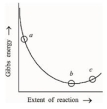
Consider the graph of $G i b b s$ free energy $G$ vs Extent of reaction. The number of statement/s from the following which are true with respect to points $(a), (b)$ and $(c)$ is $.................$

$A.$Reaction is spontaneous at $(a)$ and $(b)$

$B.$Reaction is at equilibrium at point $(b)$ and nonspontaneous at point $(c)$

$C.$Reaction is spontaneous at $(a)$ and nonspontaneous at $(c)$

$D.$Reaction is non-spontaneous at $(a)$ and $(b)$
In which of the following is the angle between the two covalent bonds greatest
In the following which substance will have highest boiling point