MCQ
Chiral complex from the following is :

Here en $=$ ethylene diamine

  • cis $-\left[ PtCl _2( en )_2\right]^{2+}$
  • B
    trans $-\left[ PtCl _2( en )_2\right]^{2+}$
  • C
    cis $-\left[ PtCl _2\left( NH _3\right)_2\right]$
  • D
    trans $-\left[ Co \left( NH _3\right)_4 Cl _2\right]^{+}$

Answer

Correct option: A.
cis $-\left[ PtCl _2( en )_2\right]^{2+}$
a
this is chiral complex form

Need a full question paper?

Generate a complete, print-ready paper with questions like this in minutes — across 16+ boards, with answer keys.

Start Generating Free

Similar questions

The amino acid which is not optically active is
$KClO _3+6 FeSO _4+3 H _2 SO _4 \rightarrow KCl +3 Fe _2\left( SO _4\right)_3+3 H _2 O$ The above reaction was studied at $300\,K$ by monitoring the concentration of $FeSO _4$ in which initial concentration was $10\,M$ and after half an hour became $8.8\,M$. The rate of production of $Fe _2\left( SO _4\right)_3$ is $........\times 10^{-6}\,mol\,L ^{-1}\,s ^{-1}$.
The correct order of spin only magnetic moment (in $BM$ ) for $M n^{2+}, C r^{2+}$ and $T i^{2+}$ ions is


Assertion : Proteins are made up of $\alpha -$ amino acids.
Reason : During denaturation, secondary and tertiary structures of proteins are destroyed.
Liquids $A$ and $B$ form ideal solution over the entire range of composition. At temperature T, equimolar binary solution of liquids $A$ and $B$ has vapour pressure $45$ Torr. At the same temperature, a new solution of $A$ and $B$ having mole fractions $x _{ A }$ and $x _{ B }$, respectively, has vapour pressure of $22.5$ Torr. The value of $x_A / x_B$ in the new solution is . . . . . that the vapour pressure of pure liquid $A$ is $20$ Torr at temperature $T$ )
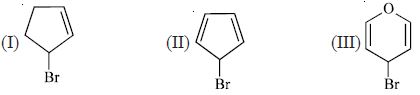
Among the bromides $I-III$ given below, the order of reactivity is $S_{N^{1}}$ reaction is :
But $-1-$ ene $\xrightarrow[{(ii)NaB{H_4}}]{{(i){{\left( {C{H_3}COO} \right)}_2}Hg/{H_2}O}}$ ? 

The product in above reaction is

Secondary alcohol is
The value of rate constant $A + B \to $ products depends on
Mixture of $PhCHO$ and $HCHO$ is treated with $NaOH$, then cannizzaro reaction involve

$(A)$ Reduction of  $HCHO$
$(B)$ Oxidation of  $HCHO$
$(C)$ Reduction of  $PhCHO$
$(D)$ Oxidation of  $Ph-CHO$