MCQ
Chloride ion and potassium ion are isoelectronic. Then
  • A
    Potassium ion is relatively bigger
  • B
    Depends on the other cation and anion
  • C
    Their size are same
  • Chloride ion is bigger than potassium ion

Answer

Correct option: D.
Chloride ion is bigger than potassium ion
d
(d) Chloride ion and potassium ion are isoelectronic, isoelectronic ions are those ions having same number of electrons.

$K = 2,\,8,\,8,\,1$                                        ${K^ + } = 2,\,8,\,8$

$Cl = 2,\,8,\,7$                                        $C{l^ - } = 2,\,8,\,8$

Need a full question paper?

Generate a complete, print-ready paper with questions like this in minutes — across 16+ boards, with answer keys.
Start Generating Free

Similar questions

The solubility products of three sparingly soluble salt  $M_2X, MX$  and  $MX_3$  are identical. What will be the order of their solubilities ?
The green colour produced in the borax bead test of a chromium$(III)$ salt is due to formation of______:
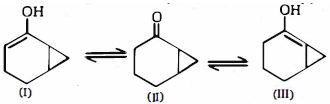
Correct stability order of the given tautomers is
For the reaction $2A_{(g)}  \rightleftharpoons  B_{(g)} + 3C_{(g)}$, at a given temperature $K_c = 16$, what must be the volume of flask. If mixture of $2\, mole$ each of $A, B, C$ exist at equilibrium?
Rank of the following groups in order of $R, S$ precedence ($IV$ is highest) 

$\mathop { - CH{{(C{H_3})}_2}}\limits_1 \,\,\,\,\,\,\,\,\,\,\,\mathop { - C{H_2}C{H_2}Br}\limits_2 \,\,\,\,\,\,\,\,\,\,\mathop{ - C{H_2}Br}\limits_3 \,\,\,\,\,\,\,\,\,\mathop{ - C{{(C{H_3})}_3}}\limits_4$

$I  =  II  =  III  = IV$

Match each of the diatomic molecules in Column $I$ with its property / properties in Column $II$.
Column $I$ Column $II$
$(A)$ $\mathrm{B}_2$ $(p)$ Paramagnetic
$(B)$ $\mathrm{N}_2$ $(q)$ Undergoes oxidation
$(C)$ $\mathrm{O}_2^{-}$ $(r)$ Undergoes reduction
$(D)$ $\mathrm{O}_2$ $(s)$ Bond order $\geq 2$
  $(t)$ Mixing of ' $\mathrm{s}$ ' and ' $\mathrm{p}$ ' orbitals
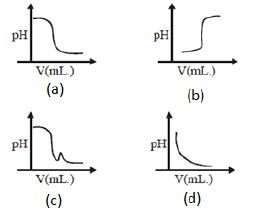
In an acid -base titration, $0.1\, M\, HCl$ solution was added to the $NaOH$ solution of unknown strength. Which of the following correctly shows the change of $pH$ of the titration mixture in this experiment?
800 g of a 40% solution by weight was cooled. 100g of solute was precipitated. The percentage composition of remaining solution is:
The compound formed in the positive test for nitrogen with the lassaigne solution of an organic compounds is
Complete combustion of $C{H_4}$ gives