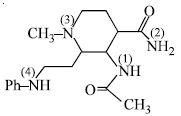
MCQ
Chlorine can remove
- ✓$Br$ from $NaBr$ solution
- B$F$ from $NaF$ solution
- C$Cl$ from $NaCl$ solution
- D$F$ from $Ca{F_2}$ solution
Generate a complete, print-ready paper with questions like this in minutes — across 16+ boards, with answer keys.
|
List $-I$ (Element) |
List $-II$ (Electronic Configuration) | ||
| $A.$ | $N$ | $I.$ | $[\mathrm{Ar}] 3 \mathrm{~d}^{10} 4 \mathrm{~s}^2 4 \mathrm{p}^5$ |
| $B.$ | $S$ | $II.$ | $[\mathrm{Ne}] 3 \mathrm{~s}^2 3 \mathrm{p}^4$ |
| $C.$ | $Br$ | $III.$ | $[\mathrm{He}] 2 \mathrm{~s}^2 2 \mathrm{p}^3$ |
| $D.$ | $Kr$ | $IV.$ | $[\mathrm{Ar}] 3 \mathrm{~d}^{10} 4 \mathrm{~s}^2 4 \mathrm{p}^6$ |
Choose the correct answer from the options given below:
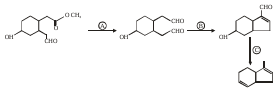
In a closed vessel follows first order kinetics. If starting with pure $N_2O(g)$ total pressure after time $'t'$ is $P_t$ and after a very long time is $P_\infty$ then which of the following expressions is correct