MCQ
Chlorobenzene is
  • Less reactive than benzyl chloride
  • B
    More reactive than ethyl bromide
  • C
    Nearly as reactive as methyl chloride
  • D
    More reactive than isopropyl chloride

Answer

Correct option: A.
Less reactive than benzyl chloride
a
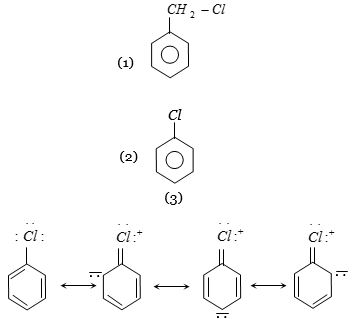
Chlorobenzene $(1)$ is less reactive than benzyl chloride $(2)$ In chlorobenzene the lone pairs present on $ Cl$  atom get involved in resonance with $\pi $electrons of benzene due to which $C - Cl$ bond acquires double bond character Hence, reactivity decreases.

$(3)$

Need a full question paper?

Generate a complete, print-ready paper with questions like this in minutes — across 16+ boards, with answer keys.

Start Generating Free

Similar questions

The mole fraction of a solute in a solution is $0.1$ . At $298 \mathrm{~K}$, molarity of t is solution is the same as its molality. Density of this solution at $298 \mathrm{~K}$ is $2.0 \mathrm{~g} \mathrm{~cm}^{-3}$. The ratio of the molecular weights of the solute and solvent, $\left(\frac{M W_{\text {solute }}}{M W_{\text {solvent }}}\right)$, is
When equal weights of the two fertilizers, urea and ammonium sulphate are taken, urea contains
What is the potential of the cell containing two hydrogen electrodes as represented below ........... $\mathrm{V}$

$Pt:\frac{1}{2}\,{H_2}\left( g \right)\,|{H^ + }\left( {{{10}^{ - 8}}\,M} \right)||{H^ + }\,\left( {{{10}^{ - 3}}\,M} \right)|\frac{1}{2}\,{H_2}\left( g \right)\,;Pt$
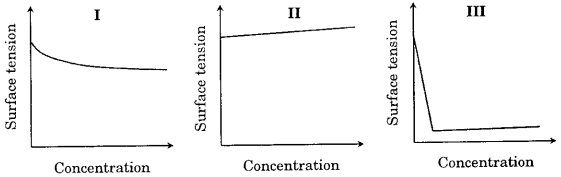
The qualitative sketches $I, II$ and $III$ given below show the variation of surface tension with molar concentration of three different aqueous solutions of $\mathrm{KCl}, \mathrm{CH}_3 \mathrm{OH}$ and $\mathrm{CH}_3\left(\mathrm{CH}_2\right)_{11} \mathrm{OSO}_3{ }^{-} \mathrm{Na}^{+}$at room temperature. The correct assignment of the sketches is
In the structure $\begin{array}{*{20}{c}}
  {C{H_3}\,\,\,\,\,\,\,\,\,\,\,} \\ 
  {|\,\,\,\,\,\,\,\,\,\,\,\,\,\,\,\,} \\ 
  {^1{H_3}C{ - ^2}C{ - ^3}C{H_2}{ - ^4}C{H_3}} \\ 
  {|\,\,\,\,\,\,\,\,\,\,\,\,\,\,\,\,} \\ 
  {C{H_{3\,\,\,\,\,\,\,\,\,\,\,\,\,\,\,\,\,}}} 
\end{array}$ Which one is quarternary carbon atom.......
To get $DDT, $ chlorobenzene has to react with which of the following compounds in the presence of concentrated sulphuric acid
We have three aqueous solutions of $\mathrm{NaCl}$ labelled as ' $A$ ', ' $B$ ' and ' $C$ ' with concentration $0.1 \mathrm{M}$, $0.01 \mathrm{M} \& 0.001 \mathrm{M}$, respectively. The value of van $t'$ Haft factor $(i)$ for these solutions will be in the order.
Which represents nucleophilic aromatic substitution reaction
Pauling's electronegativity values for elements are useful in predicting
By adding a strong acid to the buffer solution, the $pH$  of the buffer solution