MCQ
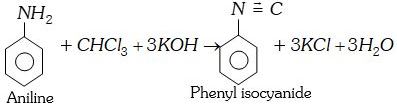
Chloroform when treated with aniline and alcoholic $KOH$ gives 
  • A
    Phenyl cyanide
  • Phenyl isocyanide
  • C
    Chlorobenzene
  • D
    Phenol

Answer

Correct option: B.
Phenyl isocyanide
b
(b)
 

Need a full question paper?

Generate a complete, print-ready paper with questions like this in minutes — across 16+ boards, with answer keys.

Start Generating Free

Similar questions

Which one is the electron deficient compound
For a chemical reaction $A + B \rightarrow$ Product, the order is $1$ with respect to $A$ and $B$.

Rate $mol\,L^{-1}\,s^{-1}$ $[A]$ $mol\,L^{-1}$ $[B]$ $mol\,L^{-1}$
$0.10$ $20$ $0.5$
$0.40$ $x$ $0.5$
$0.80$ $40$ $y$

What is the value of $x$ and $y ?$

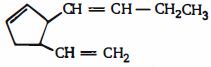
Total number of stereoisomers possible for following compound is
At $320\,K,$ a gas $A_2$ is $20\%$  dissociated to $A(g).$ The standard free energy change at  $320\,K$  and $1\,atm$   in $J\,mo1^{-1}$  is approximately

$(R= 8.314\,\,JK^{-1}\,\,mol^{-1};\,\,ln\,2 = 0.693;\,\,ln\,3 = 1.098)$
The commercial uses of $DDT$  and benzene hexachloride are
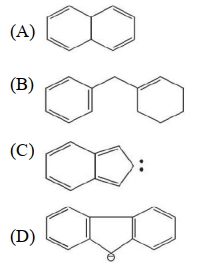
Among the given organic compounds, the total number of aromatic compounds is___________
The mechanism of the reaction $A + 2B \to D$ is

$2B\xrightarrow{k}{B_2}$        [Slow]

${B_2} + A \to D$          [Fast]

The rate law expression, order with respect to $A$, order with respect to $'B'$ and overall order are respectively

In this reaction ${C_6}{H_5}N{H_2} + HCl + NaN{O_2} \to X$. Product $X$ is
How many pairs of enantiomers are possible for following complex compound, $[M \,(AB)\, (CD) \,ef]^{n\,±}$ (where $AB,\,CD-$ Unsymmetrical bidentate ligand, $e$, $f-$ monodentate ligands)
${H_2}(g) + \frac{1}{2}{O_2}(g)\,\, \to \,\,{H_2}O(l)$; $\Delta H$ at $ 298 \,K = -285.8\, kJ$ The molar enthalpy of vaporisation of water at $ 1 $ $atm$ and ${25\,^o}C$ is $44\, kJ. $ The standard enthalpy of formation of  $1$  mole of water vapour at ${25\,^o}C$ is.......$kJ$