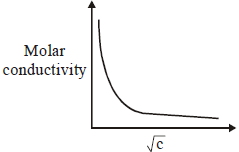
MCQ
Choose correct order
- ASolubility $Be(OH)_2 < Ba(OH)_2$
- BThermal stability $LiOH < CsOH$
- CMagnetic moment $O_2 > O_2^-$
- ✓All are correct
Generate a complete, print-ready paper with questions like this in minutes — across 16+ boards, with answer keys.
$I_2 + 2e^-\to 2I^-$ ; $E^o = 0.54 \,V$
$MnO_4^-+ 8H^+ + 5e^-\to Mn^{2+} + 4H_2O$ ; $E^o = 1.52\, V$
$Fe^{3+} + e^-\to Fe^{2+}$ ; $E^o = 0.77\, V$
$Sn^{4+} + 2e^-\to Sn^{2+}$ ; $E^o = 0.1\, V$
The strongest reducant and oxidant respectively are :
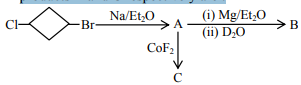
$(I)$ Glucose
$(II)$ Fructose
$(III)$ Maltose
$(IV)$ Sucrose
$(V)$ Galactose
$(A)$ the concentration of the reactant decreases exponentially with time.
$(B)$ the half-life of the reaction decreases with increasing temperature.
$(C)$ the half-life of the reaction depends on the initial concentration of the reactant
$(D)$ the reaction proceeds to $99.6 \%$ completion in eight half-life duration.
If $E_{op}^o$ for this electrode is $1.30\,volt$ then what will be the oxidation electrode potential at $pH = 3$ ? .............. $\mathrm{volt}$
The electrolyte $X$ is :