MCQ
Choose the correct alternatives:
  1. For a general rotational motion, angular momentum $L$ and angular velocity $\omega$ need not be parallel.
  2. For a rotational motion about a fixed axis, angular momentum $L \omega$ are always parallel.
  3. For a general translational motion, momentum $P$ and velocity $v$ are aways parallel.
  4. For a general translational motion, acceleration $a$ and velocity $v$ are always parallel.
  • A
    $a$ and $b$
  • $a$ and $c$
  • C
    $b$ and $d$
  • D
    All of the above

Answer

Correct option: B.
$a$ and $c$
  1. For a general rotational motion where axis of rotation is not symmetric. Angular momentum $Z$ and angular velocity $0.$ need not be parallel. The wobbly motion of a wheel rotating about an axis inclined at a small angle to the symmetry axis of the wheel represents a situation where angular momentum and angular velocity are not parallel.
  2. Fixed axis should pass through $CM$ of the body, so it is not necessary angular momentum $Z$ and angular velocity $\omega$ are always parallel.
  3. As we know in a general translational motion linear momentum is given by, $p = mv$ , hence, direction of $p$ is always along $v .$
  4. In projectile motion, $v$ and $a$ are not always parallel.

Need a full question paper?

Generate a complete, print-ready paper with questions like this in minutes — across 16+ boards, with answer keys.

Start Generating Free

Similar questions

If a satellite orbits as close to the earth's surface as possible,
If at temperature ${T_1} = 1000K,$ the wavelength is $1.4 \times {10^{ - 6}}m,$ then at ....... $K$  temperature the wavelength will be $2.8 \times {10^{ - 6}}m$
On $0^\circ C$ pressure measured by barometer is $760\, mm.$ What will be pressure on $100^\circ C$
A particle moves under the effect of a force $F = Cx$ from $x = 0$ to $x = {x_1}$. The work done in the process is
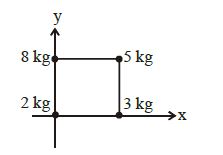
Four bodies of masses $2, 3, 5$ and $8\,kg$ are placed at the four corners of a square of side $2\,m$ as shown. The position of $CM$ will be
A cricket ball of mass $150_g$ has an initial velocity $\text{u}=(3\hat{\text{i}}+4\hat{\text{j}})\text{m s}^{-1}$ and a final velocity $\text{v}=-(3\hat{\text{i}}+4\hat{\text{j}})\text{m s}^{-1}$ after being hit. The change in momentum $($final momentum$-$initial momentum$)$ is $($in $kg\ ms^1):$
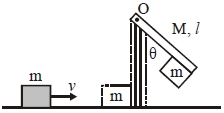
A block of mass $m =1\, kg$ slides with velocity $v=6\, m / s$ on a frictionless horizontal surface and collides with a uniform vertical rod and sticks to it as shown. The rod is pivoted about $O$ and swings as a result of the collision making angle $\theta$ before momentarily coming to rest. If the rod has mass $M =2 \,kg $ and length $l=1\, m$ the value of $\theta$ is approximately

(Take $\left.g=10 \,m / s ^{2}\right)$

The correct graph between the frequency $n$ and square root of density ($\rho$) of a wire, keeping its length, radius and tension constant, is
The time period of a satellite of earth is $5$ hours. If the separation between the earth and the satellite is increased to four times the previous value, the new time period will become ......... $hours$
The thermal conductivity of a rod depends on: