MCQ
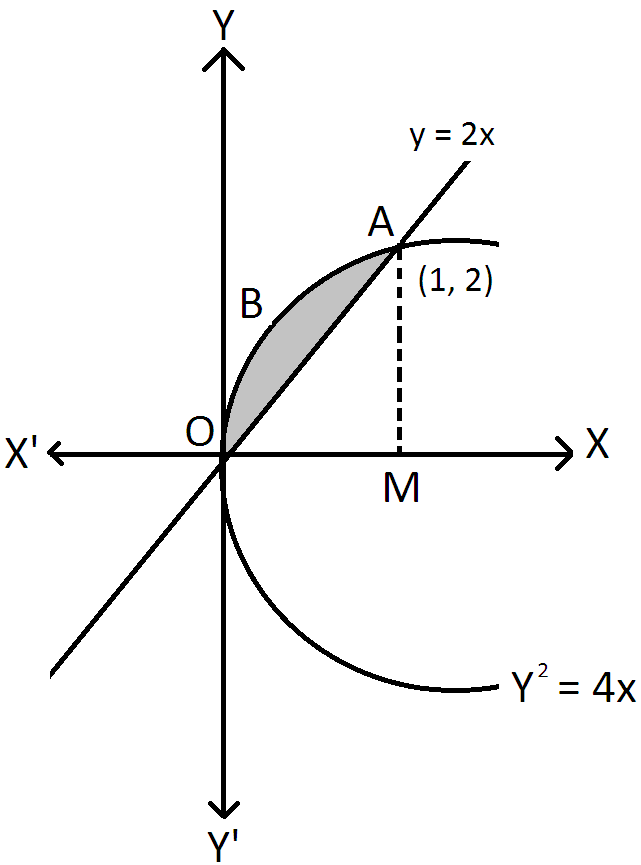
Choose the correct answer: Area lying between the curves $y^2 = 4x$ and $y = 2x$ is:
  • A
    $\frac23$
  • $\frac13$
  • C
    $\frac14$
  • D
    $\frac34.$

Answer

Correct option: B.
$\frac13$
Equation of curve $($parabola$)$ is $y^2 = 4x ...(i)$​​​​​​​
$\Rightarrow\text{y}=2\sqrt{\text{x}}=2\text{x}^{\frac12}...(\text{ii})$
Equation of another curve $($line$)$ is $y = 2x ...(iii)$ Solving $eq. (i)$ and $(iii),$
we get $x = 0$ or $x = 1$ and $y = 0$ or $y = 2$
Therefore, Points of intersections of circle $(i)$ and line $(ii)$ are $O(0, 0)$ and $A(1, 2).$
Now Area $\ce{OBAM} =$ Area bounded by parabola $(i)$ and $x-$axis $=\Bigg|\int\limits^1_0\text{ydx}\Bigg|$
$=\Bigg|\int\limits^1_02\text{x}^{\frac12}\text{dx}\Bigg|$
$= 2\frac{\Big(\text{x}^{\frac32}\Big)^1_0}{\frac32}$
$=\frac43(1-0)=\frac43\dots(\text{iv})$
Also, Area $\Delta\text{ OAM}=$ Area bounded by parabola $(iii)$ and $x-$axis
$=\Bigg|\int\limits^1_0\text{y dx}\Bigg|$
$=\Bigg|\int\limits^1_02\text{x dx}\Bigg|$
$=2\Big(\frac{\text{x}^2}{2}\Big)^1_0 $
$= (1 - 0) = 1 ...(v)$
Now Required shaded area $\ce{OBA} =$ Area $\ce{OBAM} -$ Area of $\Delta\text{ OAM}$
$=\frac43-1$
​​​​​​​$=\frac{4-3}{3}$
$=\frac13\text{ sq. units}$
Therefore, option $(B)$ is correct.

Need a full question paper?

Generate a complete, print-ready paper with questions like this in minutes — across 16+ boards, with answer keys.

Start Generating Free

Similar questions

If $\text{y}^\frac{1}{\text{n}}+\text{y}-^\frac{1}{\text{n}}=2\text{x}$ then find $(\text{x}^2 1)\text{y}_2+\text{xy}_1=$
If $\text{y}=\frac{2}{\sqrt{\text{a}^2-\text{b}^2}}\tan^{-1}\Big(\frac{\text{a}-\text{b}}{\text{a}+\text{b}}\tan\frac{\text{x}}{2}\Big),\text{a}>\text{b}>0,$then:
  1. $\text{y}_1=\frac{-1}{\text{a}+\text{b}\cos\text{x}}$
  2. $\text{y}_2=\frac{\text{b}\sin\text{x}}{(\text{a}+\text{b}\cos\text{x})^2}$
  3. $\text{y}_1=\frac{1}{\text{a}-\text{b}\cos\text{x}}$
  4. $\text{y}_2=\frac{-\text{b}\sin\text{x}}{(\text{a}-\text{b}\cos\text{x})^2}$
The area bounded by the curve $\text{y}^2=16\text{x}$  and line $\text{y}=\text{ mx}\text{ is}\frac{2}{3},$ then m is equal to:
  1. 3
  2. 4
  3. 1
  4. 2
If $f(x)=x^2 \sin \frac{1}{x}$ where $x \neq 0$ then the value of the function $f$ at $x =0$, so that the function is continuous at $x = 0 ,$ is
Region represented by $x \geq 0, y \geq 0$ is
If $y=x \log x$ then value of $\frac{d^2 y}{d x^2}$ :
The area common to the ellipse $\frac{\text{x}^2}{\text{a}^2}+\frac{\text{y}^2}{\text{b}^2}=1$ and $\frac{\text{x}^2}{\text{b}^2}+\frac{\text{y}^2}{\text{a}^2}=1,0<\text{b}<\text{a}$ is:
  1. $(\text{a}+\text{b})^2\tan^{-1}\frac{\text{b}}{\text{a}}$
  2. $(\text{a}+\text{b})^2\tan^{-1}\frac{\text{a}}{\text{b}}$
  3. $4\text{a}+\text{b}\tan^{-1}\frac{\text{b}}{\text{a}}$
  4. $4\text{a}+\text{b}\tan^{-1}\frac{\text{a}}{\text{b}}$
The diameter of a circle is increasing at the rate of 1cm/sec. When its radius is $\pi$ the rate of increase of its area is:
  1. $\pi\text{cm}^{2}/\text{sec}.$
  2. $2\pi\text{cm}^{2}/\text{sec}.$
  3. $\pi^{2}\text{cm}^{2}/\text{sec}.$
  4. $2\pi^{2}\text{cm}^{2}/\text{sec}^{2}.$ 
Refer to Question 18 (Maximum value of Z+ Minimum value of Z) is equal to:
If $\sqrt{1-\text{x}^6}+\sqrt{1-\text{y}^6}=\text{a}^3(\text{x}^3-\text{y})^3,$ then $\frac{\text{dy}}{\text{dx}}$ is equal to:
  1. $\frac{\text{x}^2}{\text{y}^2}\sqrt{\frac{1-\text{y}^6}{1-\text{x}^6}}$
  2. $\frac{\text{y}^2}{\text{x}^2}\sqrt{\frac{1-\text{y}^6}{1+\text{x}^6}}$
  3. $\frac{\text{x}^2}{\text{y}^2}\sqrt{\frac{1-\text{x}^6}{1-\text{y}^6}}$
  4. $\text{None of these.}$