MCQ
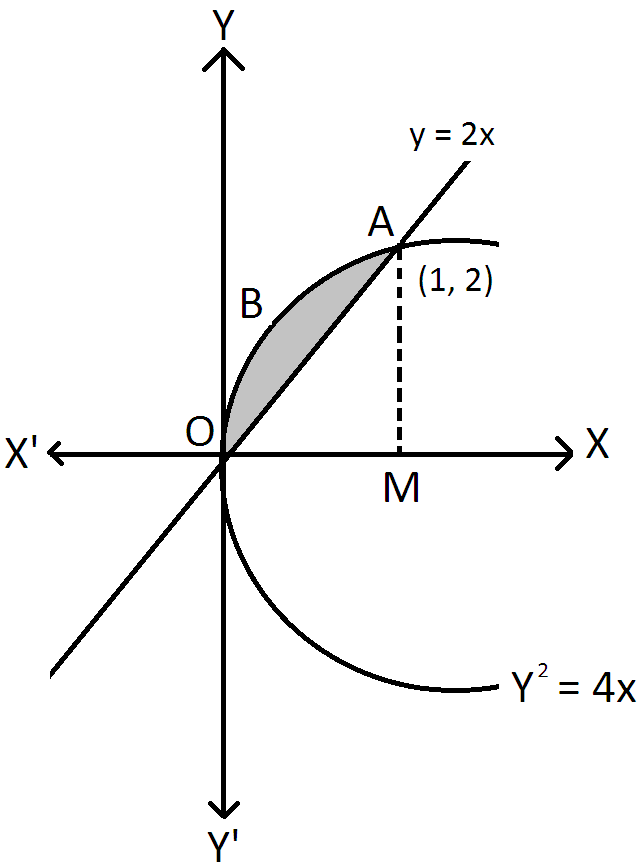
Choose the correct answer: Area lying between the curves $y^2=4 x$ and $y=2 x$ is:
  • A
    $\frac23$
  • $\frac13$
  • C
    $\frac14$
  • D
    $\frac34.$

Answer

Correct option: B.
$\frac13$

Equation of curve (parabola) is $y^2=4 x \ldots$ (i)
$\Rightarrow\text{y}=2\sqrt{\text{x}}=2\text{x}^{\frac12}...(\text{ii})$ Equation of another curve (line) is y = 2x ...(iii) Solving eq. (i) and (iii), we get x = 0 or x = 1 and y = 0 or y = 2 Therefore, Points of intersections of circle (i) and line (ii) are O(0, 0) and A(1, 2). Now Area OBAM = Area bounded by parabola (i) and x-axis $=\Bigg|\int\limits^1_0\text{y dx}\Bigg|=\Bigg|\int\limits^1_02\text{x}^{\frac12}\text{dx}\Bigg|=$ $2\frac{\Big(\text{x}^{\frac32}\Big)^1_0}{\frac32}$ $=\frac43(1-0)=\frac43\dots(\text{iv})$ Also, Area $\Delta\text{ OAM}=$ Area bounded by parabola (iii) and x-axis $=\Bigg|\int\limits^1_0\text{y dx}\Bigg|=\Bigg|\int\limits^1_02\text{x dx}\Bigg|=2\Big(\frac{\text{x}^2}{2}\Big)^1_0$ = (1 - 0) = 1 ...(v) Now Required shaded area OBA = Area OBAM - Area of $\Delta\text{ OAM}$ $=\frac43-1=\frac{4-3}{3}=\frac13\text{ sq. units}$ Therefore, option (B) is correct.

Need a full question paper?

Generate a complete, print-ready paper with questions like this in minutes — across 16+ boards, with answer keys.

Start Generating Free

Similar questions

If $y = f\left( {{{5x + 1} \over {10{x^2} - 3}}} \right)$ and $f'(x) = \cos x$, then ${{dy} \over {dx}} = $
Choose the correct answer from the given four option.
Integrating factor of the differential equation $(1-\text{x}^2)\frac{\text{d}\text{y}}{\text{d}\text{x}}-\text{xy}=1$is:
If $R$ is a relation on the set $N$, defined by $\left\{ {\left( {x,y} \right);3x + 3y = 10} \right\}$

Statement $-1$ : $R$ is symmetric

Statement $-2$ : $R$ is reflexive

Statement $-3$ : $R$ is transitive, then thecorrect sequence of given statements is

(where $T$ means true and $F$ means false)

Let $\mathrm{H}_1, \mathrm{H}_2, \ldots, \mathrm{H}_{\mathrm{n}}$ be mutually exclusive and exhaustive events with $\mathrm{P}\left(\mathrm{H}_{\mathrm{i}}\right)>0, \mathrm{i}=1,2, \ldots, \mathrm{n}$. Let $\mathrm{E}$ be any other event with $0<\mathrm{P}(\mathrm{E})<1$.

$STATEMENT -1$ : $\mathrm{P}\left(\mathrm{H}_{\mathrm{i}} \mid \mathrm{E}\right)>\mathrm{P}\left(\mathrm{E} \mid \mathrm{H}_{\mathrm{i}}\right) \cdot \mathrm{P}\left(\mathrm{H}_{\mathrm{i}}\right)$ for $\mathrm{i}=1,2, \ldots, \mathrm{n}$ because

$STATEMENT$ $-2: \sum_{1=1}^{\mathrm{n}} \mathrm{P}\left(\mathrm{H}_{\mathrm{i}}\right)=1$

The value of $b$ for which the function $f(x)=\sin x-b x+c$ is strictly decreasing for $x \in R$ is given by
If ${z^2} = {{{x^{1/2}} + {y^{1/2}}} \over {{x^{1/3}} + {y^{1/3}}}}$ then $x{{\partial z} \over {\partial x}} + y{{\partial z} \over {\partial y}} = $
Area enclosed by the circle $x^2 + y^2 = a^2$ is equal to:
If $y = 1 + x + {{{x^2}} \over {2!}} + {{{x^3}} \over {3!}} + .....\infty ,$ then ${{dy} \over {dx}} = $
The value of $C$ for which $P\,(X = k) = C{k^2}$ can serve as the probability function of a random variable $X$ that takes $0, 1, 2, 3, 4$ is
Let $\text{f(x)}=\frac{1}{1-\text{x}}.$ Then, {fo(fof)}(x):