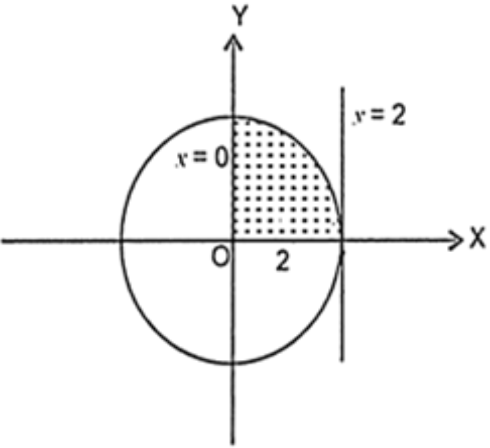
MCQ
Choose the correct answer: Area lying in the first quadrant and bounded by the circle $x^2 + y^2 = 4$ and the lines $x = 0$ and $x = 2$ is:
  • $\pi$
  • B
    $\frac{\pi}{2}$
  • C
    $\frac{\pi}{3}$
  • D
    $\frac{\pi}{4}.$

Answer

Correct option: A.
$\pi$
The equation of circle is $x^2 + y^2 = 4$
we are to find the area of the circle lying between the circle lying between the lines $x = 0$ and $x = 2$ in the first quadrant.
Required area $=\int\limits^2_0\text{y dx}$
$=\int\limits^2_0\sqrt{4-\text{x}^2}\text{dx}\ \ [\therefore$ of $(1)]$

$=\int\limits^2_0\sqrt{(2)^2-\text{x}^2}\text{ dx}$ $=\Big[\frac{\text{x}}{2}\sqrt{(2)^2-\text{x}^2}+\frac{(2)^2}{2}\sin^{-1}\Big(\frac{\text{x}}{2}\Big)\Big]^2_0$
$=\Big[\frac{\text{x}}{2}\sqrt{4-\text{x}^2}+2\sin^{-1}\Big(\frac{\text{x}}{2}\Big)\Big]^2_0$
$=\Big[\frac{\text{2}}{2}\sqrt{4-\text{4}}+2\sin^{-1}\Big(\frac{\text{2}}{2}\Big)\Big]-[0+2\sin^{-1}0]$
$=\Big[0+2\sin^{-1}(1)-[0+2\times0]\Big]$
$=2\sin^{-1}1=2\times\frac{\pi}{2}=\pi$

Need a full question paper?

Generate a complete, print-ready paper with questions like this in minutes — across 16+ boards, with answer keys.

Start Generating Free

Similar questions

Choose the correct answer from the given four options.If $\text{P}(\text{B})=\frac{3}{5},\text{P}\Big(\frac{\text{A}}{\text{B}}\Big)=\frac{1}{2}$ and $\text{P}(\text{A}\cup\text{B})=\frac{4}{5},$ then $\text{P}(\text{A}\cup\text{B})\ '+\text{P}(\text{A}\ '\cup\text{B})=$
If $\begin{vmatrix}\text{a}&\text{p}&\text{x}\\\text{b}&\text{q}&\text{y}\\\text{c}&\text{r}&\text{z}\end{vmatrix}=16,$ then the value of $\begin{vmatrix}\text{p}+\text{x}&\text{a}+\text{x}&\text{a}+\text{p}\\\text{q}+\text{y}&\text{b}+\text{y}&\text{b}+\text{q}\\\text{r}+\text{z}&\text{c}+\text{z}&\text{c}+\text{r}\end{vmatrix}$ is:
$\int_{}^{} {\sqrt {{x^2} - 8x + 7} } \;dx = $
The domain of the function $\cos ^{-1}(2 x-1)$ is
Let $I$ be the set of positve integers. $R$ is a relation on the set $I$ given by $R =\left\{ {\left( {a,b} \right) \in I \times I\,|\,\,{{\log }_2}\left( {\frac{a}{b}} \right)} \right.$ is a non-negative integer$\}$, then $R$ is 
If $\text{A}=\begin{bmatrix}\text{i}&0\\0&\text{i}\end{bmatrix},\text{n}\in\text{N},$ then $A^{4 n}$ equals :
$\int\limits^{\frac{\pi}{3}}_{\frac{\pi}{6}}\frac{1}{1+\sqrt{\cot\text{x}}}\text{ dx}$ is:
Let $[x]$ denote the integral part of $x \in R.$ $g(x) = x - [x]$. Let $f(x)$ be any continuous function with $f(0) = f(1)$ then the function $h(x) = f(g(x))$ :
For the function $\text{f}(\text{x})=\text{x}+\frac{1}{\text{x}}$
If the position vectors of  $ A, B, C, D$  are $2\,i + j,$ $i - 3\,j,$ $3\,i + 2\,j$ and $i + \lambda j$ respectively and $\overrightarrow {AB} ||\overrightarrow {CD} $ , then $\lambda $ will be