MCQ
Choose the correct answer from the given four options.
A and B are two students. Their chances of solving a problem correctly are $\frac{1}{3}$ and $\frac{1}{4},$respectively. If the probability of their making a common error is, $\frac{1}{20}$ and they obtain the same answer, then the probability of their answer to be correct is:
  • A
    $\frac{1}{12}$
  • B
    $\frac{1}{40}$
  • C
    $\frac{13}{120}$
  • D
    $\frac{10}{13}$

Answer

  1. $\frac{10}{13}$

Solution:

Let E= Event that both A and B solve the problem

$\therefore\text{P}(\text{E}_1)=\frac{1}{3}\times\frac{1}{4}=\frac{1}{12}$

Let E2 = Event that both A and B got incorrect solution of the problem

$\therefore\text{P}(\text{E}_2)=\frac{2}{3}\times\frac{3}{4}=\frac{1}{2}$

Here, $\text{P}\Big(\frac{\text{E}_1}{\text{E}}\Big)=1,\text{P}\Big(\frac{\text{E}}{\text{E}_2}\Big)=\frac{1}{20}$

 $\therefore\text{P}\Big(\frac{\text{E}_1}{\text{E}}\Big)=\frac{\text{P}(\text{E}_1\cap\text{E})}{\text{P}(\text{E})}=\frac{\text{P}(\text{E}_1)\cdot\text{P}\Big(\frac{\text{E}_1}{\text{E}}\Big)}{\text{P}(\text{E}_1)\cdot\text{P}\Big(\frac{\text{E}_1}{\text{E}}\Big)+\text{P}(\text{E}_2)\cdot\text{P}\Big(\frac{\text{E}_1}{\text{E}}\Big)} $

$=\frac{\frac{1}{12}\times1}{\frac{1}{12}\times1+\frac{1}{2}\times\frac{1}{20}}=\frac{10}{30}$

Need a full question paper?

Generate a complete, print-ready paper with questions like this in minutes — across 16+ boards, with answer keys.

Start Generating Free

Similar questions

If $\vec a,\vec b$ and  $\vec c$ are unit vectors such that $\vec a + 2\vec b + 2\vec c = \vec 0$, then $\left| {\vec a \times \vec c} \right|$ is equal to
If loge 4 = 1.3868, then loge 4.01 =
  1. 1.3968
  2. 1.3898
  3. 1.3893
  4. None of these
The differential equation which respresents the famliy of curves $\text{y}=\text{e}^{\text{Cx}}$ is:
  1. $\text{y}_{1}=\text{C}^{2}\text{y}$
  2. $\text{xy}_{1}-\log\text{y}=0$
  3. $\text{x}\log\text{y}=\text{yy}_{1}$
  4. $\text{y}\log\text{y}=\text{xy}_{1}$ 
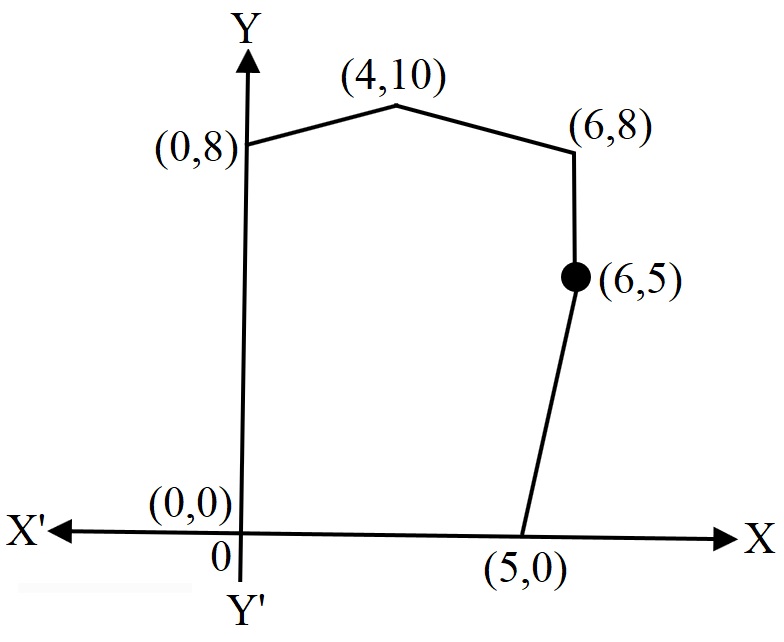
The feasible solution for a LPP is shown in the following figure. Let Z = 3x - 4y be the objective function.

Minimum of Z occurs at:

  1. (0, 0)
  2. (0, 8)
  3. (5, 0)
  4. (4, 10)
One coin is thrown $100$ times. The probability of coming tail in odd number
Let $f(x)=\max \left\{3, x^2, \frac{1}{x^2}\right\}$ for $\frac{1}{2} \leq x \leq 2$. Then, the value of the integral $\int_{1 / 2}^2 f(x) d x$ is
If $y=y(x)$ is solution of the differential equation $x\frac{{dy}}{{dx}} + 2y = {x^2}$ satisfying $y(1)=1$ then $y\left( {\frac{1}{2}} \right)$ is equal to
If the domain of the function $f(x)=\sin ^{-1}\left(\frac{x-1}{2 x+3}\right)$ is $R-(\alpha, \beta)$ then $12 \alpha \beta$ is equal to :
The number of bijective functions from set A to itself when A contains 106 elements is:
  1. 106
  2. (106)2
  3. 106!
  4. 2106
For the $LP$ problem

Maximize $z=2 x+3 y$ the coordinates of the corner points of the bounded feasible region are $A\,(3,3), B\,(20,3),$ $\mathrm{C}\,(20,10), \mathrm{D}\,(18,12)$ and $\mathrm{E}\,(12,12) .$ The maximum value of $z$ is $\ldots \ldots$