- A$12\ cm$
- ✓$14\ cm$
- C$15\ cm$
- D$18\ cm$
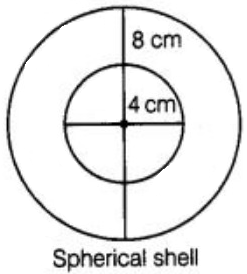
Given, internal diameter of spherical shell $= 4\ cm$
and exiernal diameter of shell $= 8\ cm$
$\therefore$ Internal radius of spherical shell $\text{r}_1=\frac{4}{2}\text{cm}=2\text{cm}$
$[\because\text{diameter}=2\times\text{radius}]$
and external radius of shell, $\text{r}_2=\frac{8}{2}=4\text{cm}$
$[\because\text{diameter}=2\times\text{radius}]$
Now, volume of the spherical shell
$=\frac{4}{3}\pi\big[\text{r}^3_2-\text{r}^3_1\big]$
$\left[\because\right.$ volume of the spherical shell $\left.=\frac{4}{3} \pi\left\{(\text { extermal radius })^3-(\text { internal radius })^3\right\}\right]$
$\frac{4}{3}\pi(4^3-2^3)$
$\frac{4}{3}\pi(64-8)$
$=\frac{224}{3}\pi\text{ \ cm}^3$
Let height of cone $= h \ cm$
Diameter of the base of cone $= 8\ cm$
$\therefore$ Radius of the base of cone $=\frac{8}{2}=4\text{cm}$
$[\because\text{diameter}=2\times\text{radius}]$
According to the question,
Volume of cone $=$ Volume of spherical shell
$\Rightarrow\ \ \frac{1}{3}\pi(4)^2\text{ h}=\frac{224}{3}\pi$
$\Rightarrow\ \text{h}=\frac{224}{16}=14\text{cm}$
$\Big[\because\text{volume of cone}=\frac{1}{3}\times\pi\times(\text{radius})^2\times(\text{height})\Big]$
Hence, the height of the cone is $14\ cm.$
Generate a complete, print-ready paper with questions like this in minutes — across 16+ boards, with answer keys.