Question
Choose the correct answer from the given four options.
If A and B are two events and $\text{A}\neq\phi,\text{B}\neq\phi,$ then:
  1. $\text{P}\Big(\frac{\text{A}}{\text{B}}\Big)=\text{P}(\text{A})\cdot\text{P}(\text{B})$
  2. $\text{P}\Big(\frac{\text{A}}{\text{B}}\Big)=\frac{\text{P}(\text{A}\cap\text{B})}{\text{P}(\text{B})}$
  3. $\text{P}\Big(\frac{\text{A}}{\text{B}}\Big)\cdot\text{P}\Big(\frac{\text{B}}{\text{A}}\Big)=1$
  4. $\text{P}\Big(\frac{\text{A}}{\text{B}}\Big)=\text{P}\Big(\frac{\text{A}}{\text{B}}\Big)$
Answer

  1. $\text{P}\Big(\frac{\text{A}}{\text{B}}\Big)=\frac{\text{P}(\text{A}\cap\text{B})}{\text{P}(\text{B})}$

Solution:

If $\text{A}\neq\phi,\text{B}\neq\phi,$ then $\text{P}\Big(\frac{\text{A}}{\text{B}}\Big)=\frac{\text{P}(\text{A}\cap\text{B})}{\text{P}(\text{B})}$

Need a full question paper?

Generate a complete, print-ready paper with questions like this in minutes — across 16+ boards, with answer keys.

Start Generating Free

Similar questions

The value of the integral $\int \limits_{-1}^{1} \log _{ e }(\sqrt{1- x }+\sqrt{1+ x }) dx$ is equal to:
If $A=\left[a_{i j}\right]$ be a $3 \times 3$ matrix, where $a_{i j}=i-3 j$, then which of the following is false?
If R is a relation on the set A = {1, 2, 3, 4, 5, 6, 7, 8, 9} given by xRy ⇔ y = 3x, then R =
  1. {(3, 1), (6, 2), (8, 2), (9, 3)}
  2. {(3, 1), (6, 2), (9, 3)}
  3. {(3, 1), (2, 6), (3, 9)}
  4. None of these.
Consider the functions defined implicitly by the equation $y^3-3 y+x=0$ on various intervals in the real line. If $x \in(-\infty,-2) \cup(2, \infty)$, the equation implicitly defines a unique real valued differentiable function $y=f(x)$. If $x \in(-2,2)$, the equation implicitly defines a unique real valued differentiable function $y=g(x)$ satisfying $g(0)=0$.

$1.$  If $\mathrm{f}(-10 \sqrt{2})=2 \sqrt{2}$, then $\mathrm{f}^{\prime \prime}(-10 \sqrt{2})=$

$(A)$ $\frac{4 \sqrt{2}}{7^3 3^2}$ $(B)$ $-\frac{4 \sqrt{2}}{7^3 3^2}$ $(C)$ $\frac{4 \sqrt{2}}{7^3 3}$ $(D)$ $-\frac{4 \sqrt{2}}{7^3 3}$

$2.$ The area of the region bounded by the curves $y=f(x)$, the $x$-axis, and the lines $x=a$ and $x=b$, where $-\infty < \mathrm{a} < \mathrm{b} < -2$, is

$(A)$ $\int_a^b \frac{x}{3\left((f(x))^2-1\right)} d x+b f(b)-a f(a)$

$(B)$ $-\int_a^b \frac{x}{3\left((f(x))^2-1\right)} d x+b f(b)-a f(a)$

$(C)$ $\int_a^b \frac{x}{3\left((f(x))^2-1\right)} d x-b f(b)+a f(a)$

$(D)$ $-\int_a^b \frac{x}{3\left((f(x))^2-1\right)} d x-b f(b)+a f(a)$

$3.$ $\int_{-1}^1 g^{\prime}(x) d x=$

$(A)$ $2 g(-1)$ $(B)$ 0 $(C)$ $-2 g(1)$ $(D)$ $2 \mathrm{~g}(1)$

Give the answer question $1,2$ and $3.$

Let the solution curve of the differential equation $x d y=\left(\sqrt{x^{2}+y^{2}}+y\right) d x, x>0$, intersect the line $x =1$ at $y =0$ and the line $x =2$ at $y =\alpha$. Then the value of $\alpha$ is.
Let f : $R \to R$ be defined by $f\left( x \right) = \ln \left( {x + \sqrt {{x^2} + 1} } \right)$ , then number of solutions of $\left| {{f^{ - 1}}\left( x \right)} \right| = {e^{ - \left| x \right|}}$ is
Integration of $\frac{1}{1+(\log_\text{e}\text{x})^2}$ with respect to $\log_\text{e}\text{x}$ is:
  1. $\frac{\tan^{-1}(\log_\text{e}\text{x})}{\text{x}}+\text{C}$
  2. $\tan^{-1}(\log_\text{e}\text{x})+\text{C}$
  3. $\frac{\tan^{-1}\text{x}}{\text{x}}+\text{C}$
  4. none of these
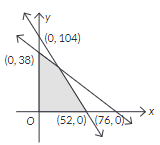
The feasible region of an LPP is given in the following figure
Image
Then, the constraints of the LPP are $x \geq 0, y \geq 0$ and
If the function $f$ defined as $f(x)\, = \frac{1}{x} - \frac{{k - 1}}{{{e^{2x}} - 1}}$ ,$x\, \ne \,0,$ is continuous at $x = 0.$ then the ordered pair  $(k,f(0))$ is equal to?
If $f(x) = x^3-x^2+100\,x \, +1001\,;$ then