MCQ
Choose the correct answer from the given four options.
If A and B are two events such that $\text{P}(\text{A})=\frac{1}{2},\text{P}(\text{B})=\frac{1}{3},$ $\text{P}\Big(\frac{\text{A}}{\text{B}}\Big)=\frac{1}{4},$ then $\text{P}(\text{A}'\cap\text{B}')$ equals:
  • A
    $\frac{1}{12}$
  • B
    $\frac{3}{4}$
  • C
    $\frac{1}{4}$
  • D
    $\frac{3}{16}$

Answer

  1. $\frac{1}{4}$

Solution:

We have, $\text{P}(\text{A})=\frac{1}{2},\text{P}(\text{B})=\frac{1}{3}$ and $\text{P}\Big(\frac{\text{A}}{\text{B}}\Big)=\frac{1}{4}$

$\Rightarrow\text{P}(\text{A}\cap\text{B})=\text{P}\Big(\frac{\text{A}}{\text{B}}\Big)\cdot\text{P}(\text{B})$

$=\frac{1}{4}\cdot\frac{1}{3}=\frac{1}{12}$

Now, $\text{P} ({\text{A}'}\cap{\text{B}'})=1-\text{P}(\text{A}\cup{\text{B}})$

$=1-\big[\text{P}(\text{A})+\text{P}(\text{B})-\text{P}(\text{A}\cap\text{B})\big]$

$=1-\Big[\frac{1}{2}+\frac{1}{3}-\frac{1}{12}\Big]=1-\frac{9}{12}$

$=\frac{3}{12}=\frac{1}{4}$

Need a full question paper?

Generate a complete, print-ready paper with questions like this in minutes — across 16+ boards, with answer keys.

Start Generating Free

Similar questions

Let $f : [1, 3] \to R$ be a function satisfying $\frac{x}{{[x]}} \le f(x) \le \sqrt {6 - x} ,$ for all $x \ne 2$ and $f(2) = 1,$ where $R$ is the set of all real numbers and $[x]$ denotes the largest integer less than or equal to $x.$

Statement $1:$ $\mathop {\lim }\limits_{x \to {2^ - }} \,f(x)$ exists.

Statement $2:$ $f$ is continuous at $x = 2.$

If f : R → R defind by $\text{f(x)}=\frac{2\text{x}-7}{4}$ is an invertible function, then find f-1.
  1. $\frac{4\text{x}+5}{2}$
  2. $\frac{4\text{x}+7}{2}$
  3. $\frac{3\text{x}+2}{2}$
  4. $\frac{9\text{x}+3}{5}$
Total number of equivalence relations defined in the set S = {a, b, c} is:
  1. 5
  2. 3!
  3. 23
  4. 33
Let the volume of tetrahedron $ABCD$ is $81$ cubic units $\&$ $G_1,G_2,G_3$ are centroids of triangular faces $ABC, ABD \, \& \,ACD$ respectively, then volume of tetrahedron $A\,G_1G_2G_3,$ is (in cubic units)
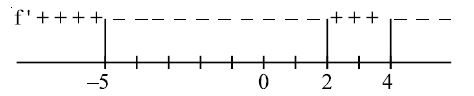
 $(i)$  $f (x)$ is continuous and defined for all real numbers

$(ii)$ $f '(-5) = 0 \,; \,f '(2)$ is not defined and $f '(4)  = 0$

$(iii)$ $(-5, 12)$ is a point which lies on the graph of $f (x)$

$(iv)$ $f ''(2)$ is undefined, but $f ''(x)$ is negative everywhere else.

$(v)$ the signs of  $f '(x)$ is given below

Possible graph of $y = f (x)$ is

If $A = \left[ {\begin{array}{*{20}{c}}4&1\\3&2\end{array}} \right]$and $I = \left[ {\begin{array}{*{20}{c}}1&0\\0&1\end{array}} \right]$, ${A^2} - 6A = $
$\int {\cos ({{\log }_e}x)\,dx} $ is equal to
If d is the determinant of a square matrix A of order n, then the determinant of its adjoint is:
  1. dn
  2. dn-1
  3. dn+1
  4. d
Let $f _1: R \rightarrow R f _2:\left(-\frac{\pi}{2}, \frac{\pi}{2}\right) \rightarrow R , f _3:\left(-1, e ^{\frac{\pi}{2}}-2\right) \rightarrow R$ and $f _4: R \rightarrow R$ be functions defined by

$(i)$ $f _1(x)=\sin \left(\sqrt{1- e ^{-x^2}}\right)$

$(ii)$ $f_2(x)=\left\{\begin{array}{ll}\frac{|\sin x|}{\tan ^{-1} x} & \text { if } x \neq 0 \\ 1 & \text { if } x=0\end{array}\right.$, where the inverse trigonometric function of $\tan ^{-1} x$

assume values in $\left(-\frac{\pi}{2}, \frac{\pi}{2}\right)$,

$(iii)$ $f_3(x)=\left[\sin \left(\log _c(x+2)\right)\right]$, where, for $t \in R ,[t]$ denotes the greatest integer less than or equal to $t$,

(iv) $f_4(x)=\left\{\begin{array}{ll}x^2 \sin \left(\frac{1}{x}\right) & \text { if } x \neq 0 \\ 0 & \text { if } x=0\end{array}\right.$

$LIST I$  $LIST II$ 
$P$ The function $f _1$ is $1$ $NOT$ continuous at $x=0$
$Q$ The function $f _2$ is $2$ continuous at $x =0$ and $NOT$ differentiable at $x =0$
$R$ The function $f_3$ is $3$ differentiable at $x=0$ and its derivative is $NO$T continuous at $x =0$
$S$ The function $f _4$ is $4$ differentiable at $x =0$ and its derivative is continuous at $x =0$

The correct option is:

Let $K$ be the set of all real values of $x$ where the function $f\left( x \right) = \sin \,\left| x \right| - \left| x \right| + 2\,\left( {x - \pi } \right)\,\cos \,\left| x \right|$ is not differentiable. Then the set $K$ is equal to