MCQ
Choose the correct answer from the given four options.
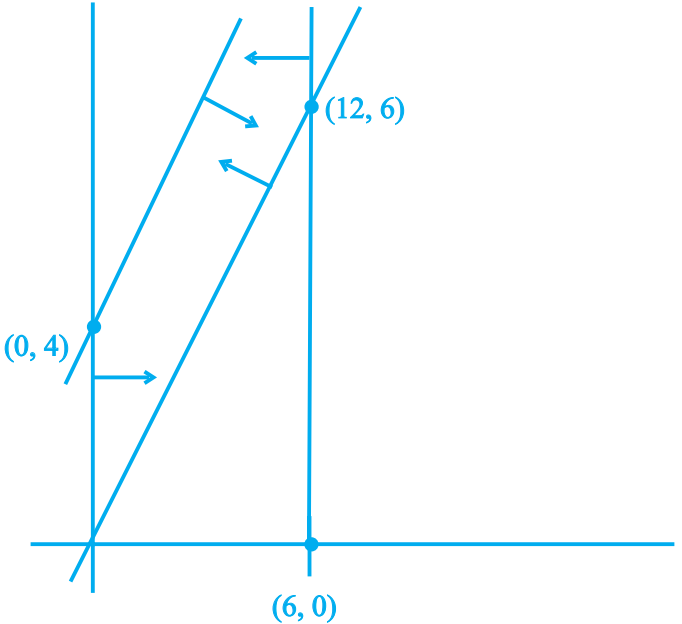
Let $F = 3x - 4y$ be the objective function. Maximum value of $F$ is:
  • A
    $0.$
  • B
    $8.$
  • $12.$
  • D
    $-18.$

Answer

Correct option: C.
$12.$
The feasible region as shown in the figure, has objective function $F = 3x - 4y$
Corner points
Corresponding value of $Z = 3x - 4y$
$(0, 0)$
$(12, 6)$
$(0, 4)$
$0$
$12 ($maximum$)$
$-16 ($minimum$)$
Hence, the maximum value of $F$ is $12.$

Need a full question paper?

Generate a complete, print-ready paper with questions like this in minutes — across 16+ boards, with answer keys.

Start Generating Free

Similar questions

The maximum number of equivalence relations on the set $A = \{1, 2, 3\}$ are:
Let $A$ be a $3 \times 3$ matrix and $\operatorname{det}(A)=2$. If ${n}=\operatorname{det}(\underbrace{\operatorname{adj}(\operatorname{adj}(\ldots . .(\operatorname{adj} A)}_{2024-\text { times }})))$  .Then the remainder when $\mathrm{n}$ is divided by $9$ is equal to
Among the relations $S =\left\{( a , b ): a , b \in R -\{0\}, 2+\frac{ a }{ b } > 0\right\}$ And $T =\left\{( a , b ): a , b \in R , a ^2- b ^2 \in Z \right\}$,
If $|a|\, = 2,\,\,|b|\, = 3$ and $a, b$  are mutually perpendicular, then the area of the triangle whose vertices are $0,\,\,a + b,\,\,a - b$ is
If $\sin^{-1}(\text{x}^2-7\text{x}+12)=\text{n}\pi,\forall\text{ n }\in\text{ I},$ then $x =$
Let $f: R \rightarrow R$ satisfy the equation $f(x+y)=f(x) \cdot f(y)$ for all $x, y \in R$ and
$f ( x ) \neq 0$ for any $x \in R .$ If Ihe function $f$ is differentiable at $x =0$ and $f^{\prime}(0)=3,$ then $\lim _{h \rightarrow 0} \frac{1}{h}(f(h)-1)$ is equal to ....... .
Let $f (x) =$ $\mathop {Lim}\limits_{h \to 0} \,\,\frac{1}{h}\int\limits_x^{x + h} {\frac{{dt}}{{t + \sqrt {1 + {t^2}} }}} $, then $\mathop {Lim}\limits_{x \to \, - \infty } \,\,x\,\cdot\,{\rm{f}}(x)$ is
The value of the definite integral $\int\limits_0^{\frac{\pi }{2}} {\sqrt {\tan x} \,dx} $, is
Solution of differential equation $\frac{{dy}}{{dx}} = \frac{{y - x}}{{y + x}}$ is
The corner points of the feasible region determined by the system of linear constraints are (0, 10), (5, 5), (15, 15), (0, 20). Let Z = px + qy, where p, q > 0. Condition on p and q so that the maximum of Z occurs at both the points (15, 15) and (0, 20) is Maximum of Z occurs at: