Question
Choose the correct answer from the given four options.

On using elementary column operations C2 → C2 – 2C1 in the following matrix equation $\begin{bmatrix}1&-3\\2&4\end{bmatrix}=\begin{bmatrix}1&-1\\0&1\end{bmatrix}\begin{bmatrix}3&1\\2&4\end{bmatrix},$ we have:

  1. $\begin{bmatrix}1&-5\\0&4\end{bmatrix}=\begin{bmatrix}1&-1\\-2&2\end{bmatrix}\begin{bmatrix}3&-5\\2&0\end{bmatrix}$

  2. $\begin{bmatrix}1&-5\\0&4\end{bmatrix}=\begin{bmatrix}1&-1\\0&1\end{bmatrix}\begin{bmatrix}3&-5\\-0&2\end{bmatrix}$

  3. $\begin{bmatrix}1&-5\\2&0\end{bmatrix}=\begin{bmatrix}1&-3\\0&1\end{bmatrix}\begin{bmatrix}3&1\\-2&4\end{bmatrix}$

  4. $\begin{bmatrix}1&-5\\2&0\end{bmatrix}=\begin{bmatrix}1&-1\\0&1\end{bmatrix}\begin{bmatrix}3&-5\\2&0\end{bmatrix}$
Answer

  1. $\begin{bmatrix}1&-5\\2&0\end{bmatrix}=\begin{bmatrix}1&-1\\0&1\end{bmatrix}\begin{bmatrix}3&-5\\2&0\end{bmatrix}$

Solution:

Given that, $\begin{bmatrix}1&-3\\2&4\end{bmatrix}=\begin{bmatrix}1&-1\\0&1\end{bmatrix}\begin{bmatrix}3&1\\2&4\end{bmatrix}$

On using C2 → C2 - 2C1$\begin{bmatrix}1&-5\\2&0\end{bmatrix}=\begin{bmatrix}1&-1\\0&1\end{bmatrix}\begin{bmatrix}3&-5\\2&0\end{bmatrix}$

Since, on using elementary column operation on X = AB, we apply these operations simultaneously on X and on the second matrix B of the product AB on RHS.

Need a full question paper?

Generate a complete, print-ready paper with questions like this in minutes — across 16+ boards, with answer keys.

Start Generating Free

Similar questions

Let $A =\left[\begin{array}{cc}1 & -1 \\ 2 & \alpha\end{array}\right]$ and $B =\left[\begin{array}{ll}\beta & 1 \\ 1 & 0\end{array}\right], \alpha, \beta \in R$. Let $\alpha_{1}$ be the value of $\alpha$ which satisfies $( A + B )^{2}= A ^{2}+\left[\begin{array}{ll}2 & 2 \\ 2 & 2\end{array}\right]$ and $\alpha_{2}$ be the value of $\alpha$ which satisfies $( A + B )^{2}= B ^{2}$. Then $\left|\alpha_{1}-\alpha_{2}\right|$ is equal to.
If f(x) = |x - 3| and g(x) = fof(x), then for x > 10, g'(x) is equal to:
  1. 1
  2. -1
  3. 0
  4. None of these.
Let $M$ be a $3 \times 3$ invertible matrix with real entries and let $I$ denote the $3 \times 3$ identity matrix. If $M ^{-1}=\operatorname{adj}(\operatorname{adj} M )$, then which of the following statement is/are $ALWAYS TRUE$ ?

$(A)$ $M=I$   $(B)$ $\operatorname{det} M =1$   $(C)$ $M ^2= I$  $(D)$ $(\operatorname{adj} M)^2=I$

For a given matrix $A =$ $\left[ {\,\begin{array}{*{20}{c}}{\cos \theta }&{ - \,\sin \theta }\\{\sin \theta }&{\cos \theta }\end{array}\,} \right]$ which of the following statement holds good?
Let  $a, b$  and $ c $ be vectors with magnitudes $3, 4$  and $5$  respectively and $a + b + c = 0, $ then the values of $ a.b + b.c + c.a$  is
The slope of the tangent at $(x,y)$to a curve passing through $\left( {1,\frac{\pi }{4}} \right)$is given by $\frac{y}{x} - {\cos ^2}\left( {\frac{y}{x}} \right)$, then the equation of the curve is
For $a > 0,\,\,t\, \in \left( {0,\frac{\pi }{2}} \right),$ let $x = \sqrt {{a^{{{\sin }^{ - 1}}\,t}}} $ and $y = \sqrt {{a^{{{\cos }^{ - 1}}\,t}}} $ Then, $1 + {\left( {\frac{{dy}}{{dx}}} \right)^2}$ equals
The number of matrices $A=\left[\begin{array}{ll}a & b \\ c & d\end{array}\right]$, where a $, b, c, d \in\{-1,0,1,2,3, \ldots \ldots, 10\}$, such that $A=A^{-1}$, is
The integral $\int\left(\frac{x}{x \sin x+\cos x}\right)^{2} d x$ is equal to

(where $C$ is a constant of integration)

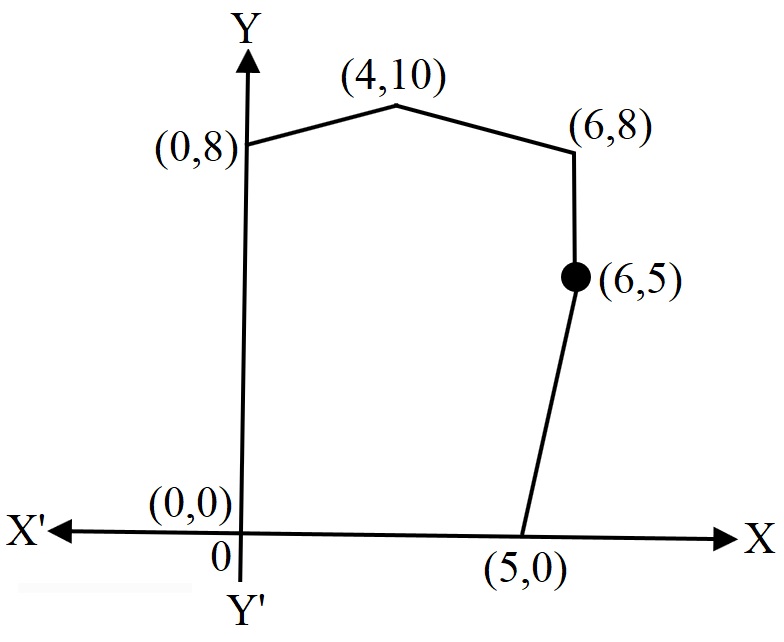
The feasible solution for a LPP is shown in the following figure. Let Z = 3x - 4y be the objective function.

Minimum of Z occurs at: