MCQ
Choose the correct answer from the given four options:
The famous mathematician associated with finding the sum of the first 100 natural numbers is:
  • Pythagoras.
  • B
    Newton.
  • C
    Gauss.
  • D
    Euclid.

Answer

Correct option: A.
Pythagoras.
Gauss is the famous mathematician associated with finding the sum of the first natural numbers i.e., 1, 2, 3 ............ 100.

Need a full question paper?

Generate a complete, print-ready paper with questions like this in minutes — across 16+ boards, with answer keys.

Start Generating Free

Similar questions

If one of the zeroes of the cubic polynomial $x^3+ ax^2+ bx + c$ is $-1,$ then the product of other two zeroes is :
Choose the correct answer from the given four options in the following questions:
If two positive integers $p$ and $q$ can be expressed as $p=a b^2$ and $q=a^3 b ; a, b$ being prime numbers, then LCM ( $p, q$ ) is:
Assertion and Reason Type
Each question consists of two statements, namely, Assertion (A) and Reason (R). For selecting the correct answer, use the following code:
Assertion (A)
Reason (R)
If the radii of the circular ends of a bucket 24cm high are 15cm and 5cm respectively, then the surface area of the bucket is $545\pi\text{cm}^2.$
if the radii of the circular ends of the frustum of a cone are R and r respectively and its height is h, surface area is:
$\pi\big\{\text{R}^2+\text{r}^2+\text{l}(\text{R}-\text{r})\big\}$
where $\text{l}^2=\text{h}^2+(\text{R}+\text{r})^2.$
If $\tan \theta=\frac{15}{8}$, then $\cot \theta= ?$
If the equation $ 9 x^2+6 k x+4=0 $, has equal roots, then the roots are both equal to.
$\Bigg\{\frac{\big(\sin^222^\circ+\sin^268^\circ\big)}{\big(\cos^222^\circ+\cos^268^\circ\big)}+\sin^263^\circ +\cos63^\circ\sin27^\circ\Bigg\}=?$
The area of a circle whose area and circumference are numerically equal, is :
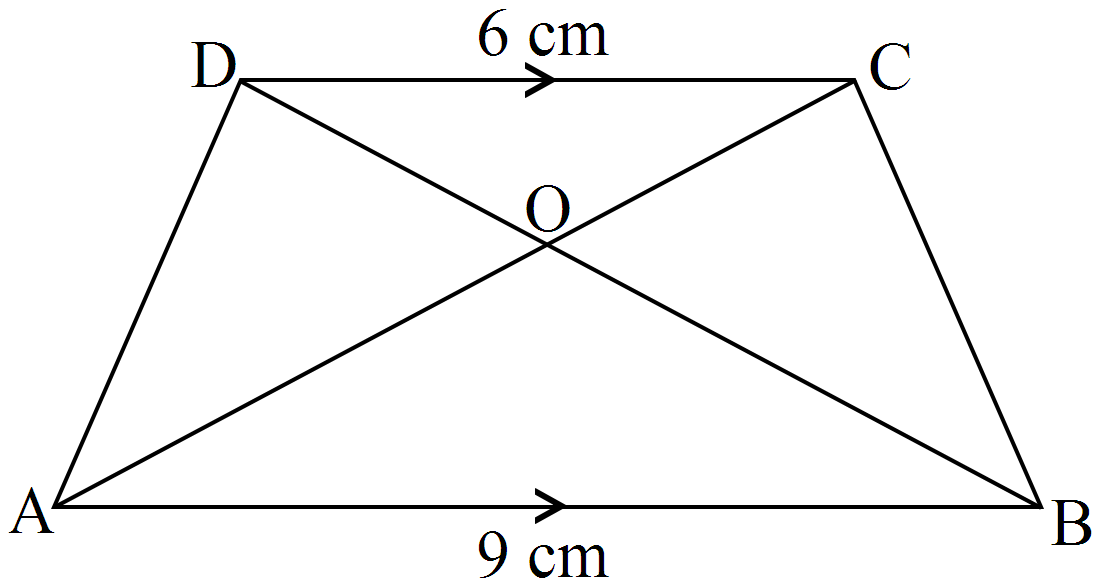
In trapezium $\text{ABCD},$ if $\text{AB}\parallel\text{DC},\text{AB}\parallel\text{DC}, AB = 9\ cm, DC = 6\ cm$ and $BD = 12\ cm,$ then $BO$ is equal to :​​​​​​​
Mark the correct alternative in the following : If the sum of $n$ terms of an $A.P.$ is $2n^2+ 5n,$ then its $n^{th}$ term is :
The first term of an $AP$ is $p$ and the common difference is $q,$ then its $10^{th}$ term is :