Question
Choose the correct answer from the given four options.
The feasible solution for a LPP is shown in. Let Z = 3x - 4y be the objective function.
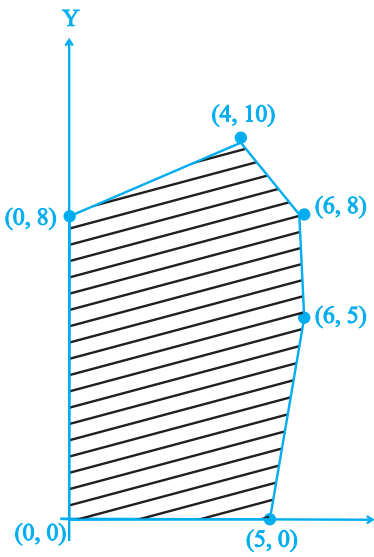
Minimum of Z occurs at:

Answer

  1. (0, 8)
Solution:
Corner points
Corresponding value of Z = 3x - 4y
(0, 0)
(5, 0)
(6, 5)
(6, 8)
(4, 10)
(0, 8)
0
15 - 2
-14
-28
-32 (Minimum)
Hence, the minimum of Z occurs at (0, 8) and its minimum value is (-32).

Need a full question paper?

Generate a complete, print-ready paper with questions like this in minutes — across 16+ boards, with answer keys.

Start Generating Free

Similar questions

Choose the correct answer in Exercise:
$\int\frac{\text{dx}}{\sqrt{9\text{x}-4\text{x}^2}}\text{equals}$
  1. $\frac{1}{9}\sin^{-1}\bigg(\frac{9\text{x}-8}{8}\bigg)+\text{C}$
  2. $\frac{1}{2}\sin^{-1}\bigg(\frac{8\text{x}-9}{9}\bigg)+\text{C}$
  3. $\frac{1}{3}\sin^{-1}\bigg(\frac{9\text{x}-8}{8}\bigg)+\text{C}$
  4. $\frac{1}{2}\sin^{-1}\bigg(\frac{9\text{x}-8}{9}\bigg)+\text{C}$
The order of differential equation  $\frac{\text{d}^2\text{y}}{\text{dx}^2}-\Big(\frac{\text{dy}}{\text{dx}^2}\Big)=1$ is:
  1. one
  2. two
  3. four
  4. zero
A(3, 2, 0), B(5, 3, 2) and  C(-9, 6, -3) are the vertices of a tringle ABC. if the bisector of $\angle\text{ABC}$ meets BC at D, then coordinates of D are:
  1. $\Big(\frac{19}{8},\frac{57}{16},\frac{17}{16}\Big)$
  2. $\Big(-\frac{19}{8},\frac{57}{16},\frac{17}{16}\Big)$
  3. $\Big(\frac{19}{8},-\frac{57}{16},\frac{17}{16}\Big)$
  4. $\text{none of these}$
If $\text{x}=2\text{ at},\text{y}=\text{at}^2,$ where a is a constant, then $\frac{\text{d}^2\text{y}}{\text{dx}^2}\text{ at}\ \text{x}=\frac{1}{2}$ is:
  1. $\frac{1}{2}\text{a}$
  2. 1
  3. 2a
  4. None of these
If $\vec{a}$ is a nonzero vector of magnitude ' $a$ ' and $\lambda$ a nonzero scalar, then $\lambda \vec{a}$ is unit vector if :
If the set A contains 7 elements and the set B contains 10 elements, then the number one-one functions from A to B is:
  1. $^{10}\text{C}_7$
  2. $^{10}\text{C}_7\times7!$
  3. $7^{10}$
  4. $10^7$
The area of the plane region bounded by the curves $x + 2y^2 = 0$ and $x + 3y^2 = 1$ is equal to$:$
At $\text{x}=\frac{5\pi}{6}, $ $\text{f}(\text{x})=2\sin3\text{x}+3 \cos3\text{x}$ is:
  1. 0
  2. maximum.
  3. minimum.
  4. none of these.
If $\vec{b}$ and $\vec{c}$ are any two non-collinear unit vectors and $\vec{a}$ is any vector, then find the value of $(\vec{a} \cdot \vec{b}) \vec{b}+(\vec{a} \cdot \vec{c}) \vec{c}+\frac{\vec{a} \cdot(\vec{b} \times \vec{c})}{|\vec{b} \times \vec{c}|} \cdot(\vec{b} \times \vec{c})$.
If $\sin ^{-1}\left(\frac{1}{2}\right)=x$ then find the general value of $x$ :