MCQ
Choose the correct answer from the given four options. The feasible solution for a $\text{LPP}$ is shown in. Let $Z = 3x - 4y$ be the objective function. Maximum of $Z$ occurs at :
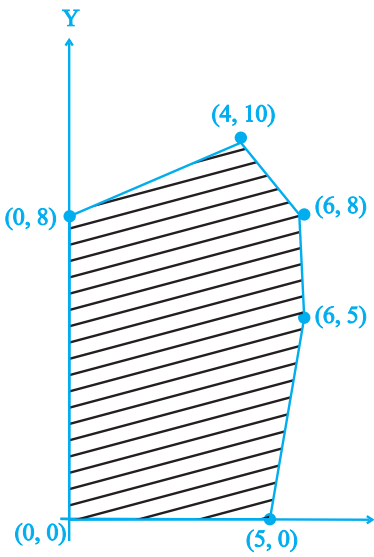
  • $(5, 0)$
  • B
    $(6, 5)$
  • C
    $(6, 8)$
  • D
    $(4, 10)$

Answer

Correct option: A.
$(5, 0)$
Corner points
Corresponding value of $Z = 3x - 4y$
$(0, 0)$
$(5, 0)$
$(6, 5)$
$(6, 8)$
$(4, 10)$
$(0, 8)$
$0$
$15 ($Maxmimum)
$-2$
$-14$
$-28$
$-32$
Hence, maximum of $Z$ occurs at $(5, 0)$ and its maximum value is $27.$

Need a full question paper?

Generate a complete, print-ready paper with questions like this in minutes — across 16+ boards, with answer keys.

Start Generating Free

Similar questions

Let $f : R \to R$ be defined by $f\left( x \right) = \frac{{\left| x \right| - 1}}{{\left| x \right| + 1}}$ then $f$ is
Find the values of $a, \,b,\, c,$ and $d$ from the following equation:

$\left[\begin{array}{cc}
2 a+b & a-2 b \\
5 c-d & 4 c+3 d
\end{array}\right]=\left[\begin{array}{cc}
4 & -3 \\
11 & 24
\end{array}\right]$

Let $f :\left[\frac{1}{2}, 1\right] \rightarrow R$ (the set of all real numbers) be a positive, non-constant and differentiable function such that $f^{\prime}(x)<2 f(x)$ and $f\left(\frac{1}{2}\right)=1$. Then the value of $\int_{1 / 2}^1 f(x) d x$ lies in the interval
In the interval $[0, 1]$ , the function ${x^2} - x + 1$ is
Which of the following represents equal vectors:
On the interval $[0, 1],$  the function ${x^{25}}{(1 - x)^{75}}$ takes its maximum value at the point
If the matrix $A=\left[\begin{array}{ccc}1 & 0 & 0 \\ 0 & 2 & 0 \\ 3 & 0 & -1\end{array}\right]$ satisfies the equation $A ^{20}+\alpha A ^{19}+\beta A =\left[\begin{array}{lll}1 & 0 & 0 \\ 0 & 4 & 0 \\ 0 & 0 & 1\end{array}\right]$ for some real numbers $\alpha$ and $\beta$, then $\beta-\alpha$ is equal to ........ .
The equation of the normal to the curve $x = a \cos^3 \theta , y = a \sin^3 \theta$ at the point $\theta=\frac{\pi}{4}$ is:
Let $y=y(x)$ be the solution of the differential equation

$\frac{d y}{d x}=1+x e^{y-x},-\sqrt{2}\,<\,x\,<\,\sqrt{2}, y (0)=0$ then, the minimum value of $y(x)$ , $\mathrm{x} \in(-\sqrt{2}, \sqrt{2})$ is equal to:

If $\text{A}=\begin{vmatrix}\text{a}_{11}&\text{a}_{12}&\text{a}_{13}\\\text{a}_{21}&\text{a}_{22}&\text{a}_{23}\\\text{a}_{31}&\text{a}_{32}&\text{a}_{33}\end{vmatrix}$ and $C_\text{ij}$ is cofactor of $a_\text{ij}$ in $a$, then value of $|A|$ is given by: