Question
Choose the correct answer from the given four options.
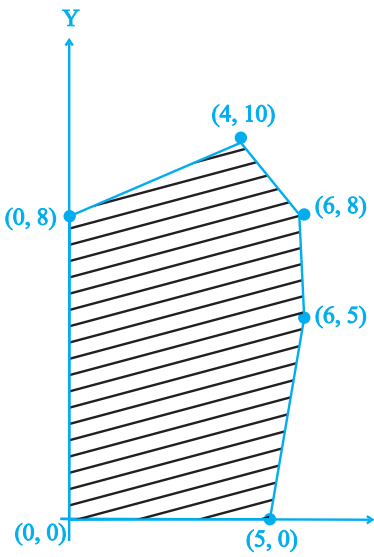
The feasible solution for a LPP shown in Fig. 12.12. Let z = 3x - 4y be objective functio. (Maximum value of Z + Minimum value of Z) is equal to:

Answer

  1. -17.
Solution:
Corner points
Corresponding value of Z = 3x - 4y
(0, 0)
(5, 0)
(6, 5)
(6, 8)
(4, 10)
(0, 8)
0
15 (Maximum)
-2
-14
-28
-32 (Minimum)
Here, maximum value of Z + minimum value of Z = 15 - 32 = -17.

Need a full question paper?

Generate a complete, print-ready paper with questions like this in minutes — across 16+ boards, with answer keys.

Start Generating Free

Similar questions

The probability distribution of a discrete random variable X is given below:
$\text{X}:$ $2$ $3$ $4$ $5$
$\text{P}(\text{X}):$ $\frac{5}{\text{k}}$ $\frac{7}{\text{k}}$ $\frac{9}{\text{k}}$ $\frac{11}{\text{k}}$
The value of k is:
The degree of the differntial equation $\left\{5+\Big(\frac{\text{dy}}{\text{dx}}\Big)^{2}\right\}^{\frac{5}{3}}=\text{x}^{5}\Big(\frac{\text{d}^{2}\text{y}}{\text{dx}^{2}}\Big)$ is:
  1. 4
  2. 2
  3. 5
  4. 10
If $\text{y}=\tan^{-1}\Big(\frac{\sin\text{x}+\cos\text{x}}{\cos\text{x}-\sin\text{x}}\Big),$ then $\frac{\text{dy}}{\text{dx}}$ is equals to:
  1. $\frac{1}{2}$
  2. 0
  3. 1
  4. None of these.
The area bounded by the curve $y = x^2 + 4x + 5,$ the axes of coordinates and minimum ordinate is$:$
If $\vec{\text{a}}$ and $\vec{\text{b}}$ be two unit vectors and $\theta$ the angle between them, than $\vec{\text{a}}+\vec{\text{b}}$ is a unit vector if $\theta=$
  1. $\frac{\pi}{4}$
  2. $\frac{\pi}{3}$
  3. $\frac{\pi}{2}$
  4. $\frac{2\pi}{3}$
The number of arbitrary constants in the particular solution of a differential equation of third order is:
  1. 3
  2. 2
  3. 1
  4. 0
One hundred idential coins, each with probability p of showing heads are tossed once. If 0 < p < 1 and the probability of heads showing on 50 coins is equal to that of heads showing on 51 coins, the value of p is:
  1. $\frac{1}{2}$
  2. $\frac{51}{101}$
  3. $\frac{49}{101}$
  4. $\text{None of these}$
If the vectors $3\hat{\text{i}}+\lambda\hat{\text{j}}+\hat{\text{k}}$ and $2\hat{\text{i}}-\hat{\text{j}}+8\hat{\text{k}}$ are perpendicular, then $\lambda$ is equal to: 
  1. $-14$
  2. $7$
  3. $14$
  4. $\frac{1}{7}$
The position vectors of the points A, B, C are $2\hat{\text{i}}+\hat{\text{j}}-\hat{\text{k}},\ 3\hat{\text{i}}-2\hat{\text{j}}+\hat{\text{k}}$ and $\hat{\text{i}}+4\hat{\text{j}}-3\hat{\text{k}}$ respectively. These points,
  1. Form an isosceles triangle.
  2. Form a right triangle.
  3. Are collinear.
  4. Form a scalene triangle.
A fair die is thrown twenty times. The probability that on the tenth throw the fourth six appears is: