MCQ
Choose the correct answer from the given four options.
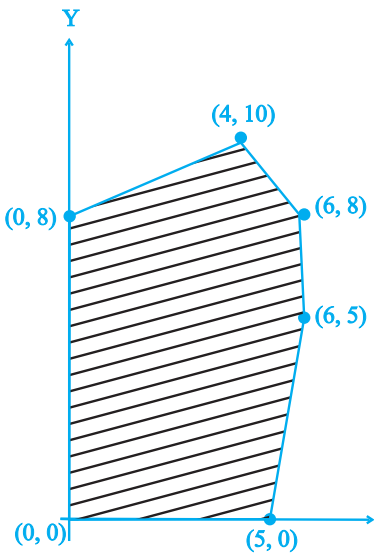
The feasible solution for a LPP shown in Fig. 12.12. Let z = 3x - 4y be objective functio. (Maximum value of Z + Minimum value of Z) is equal to:
  • A
    13.
  • B
    1.
  • C
    -13.
  • -17.

Answer

Correct option: D.
-17.
 
Corner points
Corresponding value of Z = 3x - 4y
(0, 0)
(5, 0)
(6, 5)
(6, 8)
(4, 10)
(0, 8)
0
15 (Maximum)
-2
-14
-28
-32 (Minimum)
Here, maximum value of Z + minimum value of Z = 15 - 32 = -17.

Need a full question paper?

Generate a complete, print-ready paper with questions like this in minutes — across 16+ boards, with answer keys.

Start Generating Free

Similar questions

The distance between the planes given by $r.(i + 2j - 2k) + 5 = 0$ and $r.(i + 2j - 2k) - 8 = 0$ is
If $f\left( x \right)\left\{ {\begin{array}{*{20}{c}}
  {\frac{{\sin \,\left( {p + 1} \right)x + \sin \,x}}{x},\,\,}&{x < 0} \\ 
  {q\,\,\,\,\,\,\,\,\,\,\,\,\,\,\,\,\,\,\,\,\,\,\,\,\,\,\,\,\,\,\,\,\,,}&{x = 0} \\ 
  {\frac{{\sqrt {x + {x^2}}  - \sqrt x }}{{x/2}},}&{x > 0} 
\end{array}} \right.$ Is continuous at $x = 0$, then the ordered pair $(p, q)$ is equal to
If $\vec a$ and $\vec b$ are perpendicular unit vectors and vector $\vec c$ is such that $\vec c = \vec a + \vec b$ , then $\left( {\vec a \times \vec b} \right).\left( {\vec b \times \vec c} \right) + \left( {\vec b \times \vec c} \right).\left( {\vec c \times \vec a} \right) + \left( {\vec c \times \vec a} \right).\left( {\vec a \times \vec b} \right)$ is
The solution of the equation $\frac{d y}{d x}=e^{x-y}$ is :
A box contain $100$ pens of which $10$ are defective. What is the probability that out of a sample of $5$ pens draws one by one with replacement at most one is defective?
Let $\times$ be a binary operation on set of integers I, defined by $a \times b = a + b - 3,$ then find the value of $3 \times 4.$
Choose the correct answer from the given four options. Let
$\text{f}:\text{R}-\Big\{\frac{3}{5}\Big\}\rightarrow\ \text{R}$ be defined by $\text{f}(\text{x})=\frac{3\text{x}+2}{5\text{x}-3}.$ Then,
The area of the ellipse $\frac{\text{x}2}{9}+\frac{\text{y}^2}{4}=1$ in first quadrant is $6\pi\ \text{sq. units}.$The ellipse is rotated about its centre in anti$-$clockwise direction till its major axis coincides with $y-$axis. Now the area of the ellipse in first Quadrant is $\pi\ \text{sq. units}.$
$\tan \left( {2{{\cos }^{ - 1}}\frac{3}{5}} \right) = $
Equations $x + y = 2,\,\,2x + 2y = 3$will have