MCQ
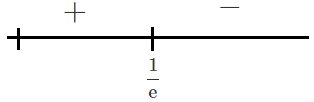
Choose the correct answer from the given four options : The maximum value of $\Big(\frac{1}{\text{x}}\Big)^\text{x}$ is :
- A$\text{e}$
- B$\text{e}^\text{e}$
- ✓$\frac{1}{_\text{e}\text{e}}$
- D$\Big(\frac{1}{\text{e}}\Big)^{\frac{1}{\text{e}}}$
Generate a complete, print-ready paper with questions like this in minutes — across 16+ boards, with answer keys.
| Column $I$ | Column $II$ |
| $(A)$ Interval contained in the domain of definition of non-zero solutions of the differential equation $(x-3)^2 y^{\prime}+y=0$ | $(p)$ $\left(-\frac{\pi}{2}, \frac{\pi}{2}\right)$ |
|
$(B)$ Interval containing the value of the integral $\int_1^5(x-1)(x-2)(x-3)(x-4)(x-5) d x$ |
$(q)$ $\left(0, \frac{\pi}{2}\right)$ |
| $(C)$ Interval in which at least one of the points of local maximum of $\cos ^2 x+\sin x$ lies | $(r)$ $\left(\frac{\pi}{8}, \frac{5 \pi}{4}\right)$ |
| $(D)$ Interval in which $\tan ^{-1}(\sin x+\cos x)$ is increasing | $(s)$ $\left(0, \frac{\pi}{8}\right)$ |
| $(t)$ $(-\pi, \pi)$ |