MCQ
Choose the correct answer from the given four options. The vectors from origin to the points $A$ and $B$ are $\vec{\text{a}}=2\hat{\text{i}}-3\hat{\text{j}}+2\hat{\text{k}}$ and $\vec{\text{b}}=2\hat{\text{i}}+3\hat{\text{j}}+\hat{\text{k}},$ respectively, then the area of the triangle $\text{OAB}$ is :
  • A
    $340$
  • B
    $\sqrt{25}$
  • C
    $\sqrt{229}$
  • $\frac{1}{2}\sqrt{229}$

Answer

Correct option: D.
$\frac{1}{2}\sqrt{229}$
$\therefore$ Area of $\triangle\text{OAB}=\frac{1}{2}|\overrightarrow{\text{OA}}\times\overrightarrow{\text{OB}}|$
$=\frac{1}{2}|(2\hat{\text{i}}-3\hat{\text{j}}+2\hat{\text{k}})\times(2\hat{\text{i}}+3\hat{\text{j}}+\hat{\text{k}})|$
$=\frac{1}{2}\begin{vmatrix}\hat{\text{i}}&\hat{\text{j}}&\hat{\text{k}} \\2&-3&2\\2&3&1 \end{vmatrix}$
$=\frac{1}{2}|[\hat{\text{i}}(-3-6)-\hat{\text{j}}(2-4)+\hat{\text{k}}(6+6)]|$
$=\frac{1}{2}|-9\hat{\text{i}}+2\hat{\text{j}}+12\hat{\text{k}}|$
$\therefore$ Area of $\triangle\text{OAB}=\frac{1}{2}\sqrt{81+4+144}$
$=\frac{1}{2}\sqrt{229}$

Need a full question paper?

Generate a complete, print-ready paper with questions like this in minutes — across 16+ boards, with answer keys.

Start Generating Free

Similar questions

The real value of $m$ for which the substitution, $y = u^m$ will transform the differential equation,$2x^4y \frac{{dy}}{{dx}} + y^4 = 4x^6$ into a homogeneous equation is :
If $R$ denotes the set of all real numbers then the function $f:R \to R$ defined $f(x) = \;[x]$
Let $\vec a,\vec b\;$ and $\;\vec c$ be three unit vectors such that  $\vec a \times \left( {\vec b \times \vec c} \right) = \frac{{\sqrt 3 }}{2}\left( {\vec b + \vec c} \right)$ . If  $\vec b$ is not parallel to $\vec c$ then angle between $\vec a\;$ and $\;\vec b$ is :
Consider the integral

$I=\int_{0}^{10} \frac{[x] e^{[x]}}{e^{x-1}} d x,$

where $[ x ]$ denotes the greatest integer less than or equal to $x$. Then the value of $I$ is equal to:

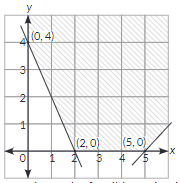
A linear programming problem (LPP) along with the graph of its constraints is shown below. The corresponding objective function is
Minimize: $Z=3 x+2 y$. The minimum value of the objective function is obtained at the corner point ( 2 , 0).
The optimal solution of the above linear programming problem $\qquad$
Image
${10^{ - x\,\tan x}}\left[ {{d \over {dx}}({{10}^{x\tan x}})} \right]$ is equal to
For any two events $A$ and $B,$ if $P(\bar{A})=\frac{1}{2}, P(\bar{B})=\frac{2}{3}$ and $P(A \cap B)=\frac{1}{4}$, then $P(\bar{A} / \bar{B})$ equals:
The maximum value of Z = 4x + 3y subjected to the constraints 3x + 2y ≥ 160, 5x + 2y ≥ 200, x + 2y ≥ 80, x, y ≥ 0 is:
A cylindrical tank of radius 10m is being filled with wheat at the rate of 314 cubic metre per hour. Then the depth of the wheat is increasing at the rate of:
Let the mean and the standard deviation of the probability distribution

$X$ $\alpha$ $1$ $0$ $-3$
$P(X)$ $\frac{1}{3}$ $K$ $\frac{1}{6}$ $\frac{1}{4}$

be $\mu$ and $\sigma$, respectively. If $\sigma-\mu=2$, then $\sigma+\mu$ is equal to....................