Question
Choose the correct answer in Exercise:
$\int^{\sqrt{3}}_{1}\frac{\text{dx}}{1+\text{x}^{2}}\text{equals}$
  1. $\frac{\pi}{3}$
  2. $\frac{2\pi}{3}$
  3. $\frac{\pi}{6}$
  4. $\frac{\pi}{12}$

Answer

  1. $\frac{\pi}{12}$
$\int\frac{\text{dx}}{1+\text{x}^{2}}=\tan^{-1}\text{x}=\text{F}\text{(x)}$
By second fundamental theorem of calculus, we obtain
$\int\limits_{1}^{\sqrt{3}}\frac{\text{dx}}{1+\text{x}^{2}}=\text{F}(\sqrt{3})-\text{F}(1)$
$=\tan^{-1}\sqrt{3}-\tan^{-1}1$
$=\frac{\pi}{3}-\frac{\pi}{4}$
$=\frac{\pi}{12}$

Need a full question paper?

Generate a complete, print-ready paper with questions like this in minutes — across 16+ boards, with answer keys.

Start Generating Free

Similar questions

If $\vec{\text{a}},\ \vec{\text{b}}$ are the vectors forming consecutive sides of a regular hexagon ABCDEF, then the vector representing side CD is,
  1. $\vec{\text{a}}+\vec{\text{b}}$
  2. $\vec{\text{a}}-\vec{\text{b}}$
  3. $\vec{\text{b}}-\vec{\text{a}}$
  4. $-\big(\vec{\text{a}}+\vec{\text{b}}\big)$
The matrix $\text{A}=\begin{bmatrix}0&\text{amp};0&\text{amp};0\\0&\text{amp};4&\text{amp};0\\4&\text{amp};0&\text{amp};0\end{bmatrix}$ is a:
  1. Square matrix
  2. Diagonal matrix
  3. Unit matrix
  4. None of these
If $\big[2\vec{\text{a}}+4\vec{\text{b}}\vec{\text{c}}\vec{\text{d}}\big]=\lambda\big[\vec{\text{a}}\vec{\text{c}}\vec{\text{d}}\big]+\mu\big[\vec{\text{b}}\vec{\text{c}}\vec{\text{d}}\big],$ then $\lambda+\mu=$
  1. 6
  2. -6
  3. 10
  4. 8
If a, b, c are distinct, then the value of x satisfying $\begin{vmatrix}0&\text{x}^2-\text{a}&\text{x}^3-\text{b}\\\text{x}^2+\text{a}&0&\text{x}^2+\text{c}\\\text{x}^4+\text{b}&\text{x}-\text{c}&0\end{vmatrix}=0$ is:
  1. c
  2. a
  3. b
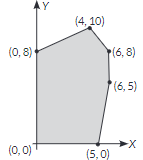
In the given graph, the feasible region for a LPP is shaded. The objective function $Z=2 x-3 y$, will be minimum at
Image
If $\tan^{-1}3+\tan^{-1}\text{x}=\tan^{-1}8,$ then x =
  1. $5$
  2. $\frac{1}{5}$
  3. $\frac{5}{14}$
  4. $\frac{14}{5}$
If $\left|\begin{array}{ll}x & 2 \\ 18 & x\end{array}\right|=\left|\begin{array}{ll}6 & 2 \\ 18 & 6\end{array}\right|$ then the value of $x$ is-
Let $A=\left|\begin{array}{ll}1 & 0 \\ 0 & 0\end{array}\right|$, then
If matrix $A$ and $B$ has order respectively $m \times n$ and $n \times p$ then order of AB is :
If $A=\{1,2,3\}$ and a relation $R$ is such that$R =\{(1,3),(2,2),(3,2)\}$ then for making R reflexive and symmetric set of minimum ordered pair is :