Question
Choose the correct answer in Exercise:

The value of $\int^{\frac{\pi}{2}}\limits_{0}\log\bigg(\frac{4+3\sin\text{x}}{4+3\cos\text{x}}\bigg)\text{dx}\ $is

  1. 2

  2. $\frac{3}{4}$

  3. 0

  4. -2


Answer

  1. 0

$\text{Let}\ \text{I}=\int^{\frac{\pi}{2}}\limits_{0}\log\bigg(\frac{4+3\sin\text{x}}{4+3\cos\text{x}}\bigg)\text{dx}\ \ \ ....(1)$

$\Rightarrow\ \ \ \text{I}=\int^{\frac{\pi}{2}}\limits_{0}\log\begin{bmatrix} \frac{4+3\sin\bigg(\frac{\pi}{2}-\text{x}\bigg)}{4+3\cos\bigg(\frac{\pi}{2}-\text{x}\bigg)}\text{dx}\\ \end{bmatrix}\text{dx}=\int^{\frac{\pi}{2}}\limits_{0}\log\bigg[\frac{4+3\cos\text{x}}{4+3\sin\text{x}}\bigg]\text{dx}\ \ \ ....(2)$

Adding eq. (i) and (ii),

$2\text{I}=\int^{\frac{\pi}{2}}\limits_{0}\bigg[\log\bigg(\frac{4+3\sin\text{x}}{4+3\cos\text{x}}\bigg)+\log\bigg(\frac{4+3\cos\text{x}}{4+3\sin\text{x}}\bigg)\bigg]\text{dx}=\int^{\frac{\pi}{2}}\limits_{0}\bigg[\log\bigg(\frac{4+3\sin\text{x}}{4+3\sin\text{x}}\bigg)\bigg(\frac{4+3\cos\text{x}}{4+3\sin\text{x}}\bigg)\bigg]\text{dx}$

$\Rightarrow\ \ \ 2\text{I}=\int^{\frac{\pi}{2}}\limits_{0}(\log1)\text{dx}=\int^{\frac{\pi}{2}}\limits_{0}0\ \text{dx}=0\ \ \ \ \ \Rightarrow\text{I}=0$

Need a full question paper?

Generate a complete, print-ready paper with questions like this in minutes — across 16+ boards, with answer keys.
Start Generating Free

Similar questions

Let $f(x)$ be a positive function such that the area bounded by $y=f(x), y=0$ from $x=0$ to $x=a>0$ is $\mathrm{e}^{-\mathrm{a}}+4 \mathrm{a}^2+\mathrm{a}-1$. Then the differential equation, whose general solution is $y=c_1 f(x)+c_2$, where $c_1$ and $c_2$ are arbitrary constants, is :
If $(x,\,y) \in R$ and $x,\;y \ne 0$; $f(x,\;y) \to \frac{x}{y}$, then this function is a/an
If $A$ and $ B$ are two square matrices such that $B = - {A^{ - 1}}BA$, then ${(A + B)^2} = $
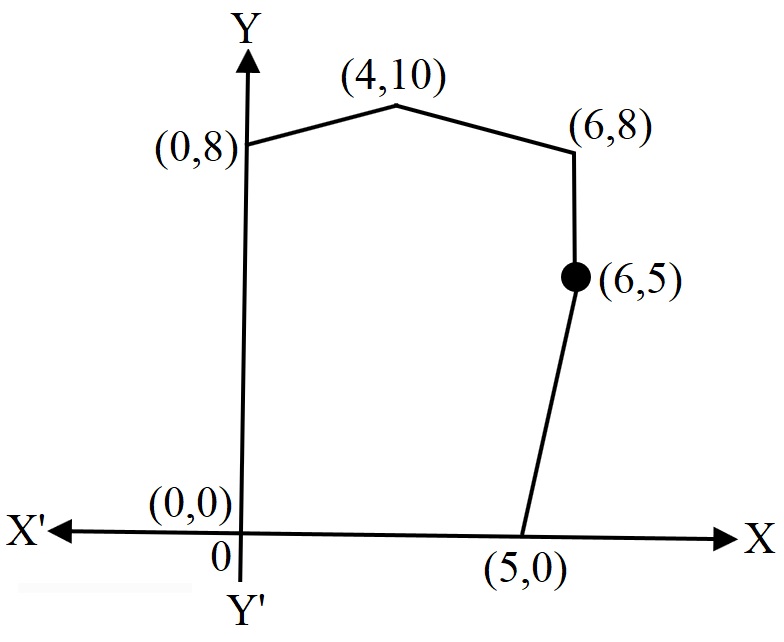
The feasible solution for a LPP is shown in the following figure. Let Z = 3x - 4y be the objective function.

Minimum of Z occurs at:

A line OP where O = (0, 0, 0) makes equal angles with ox, oy, oz. The point on OP, which is at a distance of 6 units from O is:

  1. $\Big(\frac{6}{\sqrt{3}},\frac{6}{\sqrt{3}},\frac{6}{\sqrt{3}}\Big)$

  2. $\big(2\sqrt{3},-2\sqrt{3},2\sqrt{3}\big)$

  3. $-\big(2\sqrt{3},-2\sqrt{3},2\sqrt{3}\big)$

  4. $-\big(6\sqrt{3},-6\sqrt{3},6\sqrt{3}\big)$

If the constraints in a linear programming problem are changed
  1. the problem is to be re-evaluated
  2. solution is not defined
  3. the objective function has to be modified
  4. the change in constraints is ignored
The matrix $\text{A}=\begin{bmatrix}0&\text{amp};0&\text{amp};0\\0&\text{amp};4&\text{amp};0\\4&\text{amp};0&\text{amp};0\end{bmatrix}$ is a:
  1. Square matrix
  2. Diagonal matrix
  3. Unit matrix
  4. None of these
The area of a triangle with vertices $(-3,0)$, $(3,0)$ and $(0, k)$ is 9 sq. units. The value of $k$ will be
If ${\tan ^{ - 1}}x + {\tan ^{ - 1}}y = \frac{\pi }{4}$ then
If $\int_a^b {{x^3}dx} = 0$ and $\int_a^b {{x^2}} dx = \frac{2}{3}$, then the value of $a$ and $b$ will be respectively